The Real Cost of Kart Racing: A 2026 Season Budget Breakdown
What kart racing really costs in 2026, tier by tier: rental sessions, owning a kart, club racing, national and international seasons, in real euro ranges.
How much does kart racing cost? Ask around a paddock and you'll get the same shrug everywhere. "It depends."
True, and useless. A parent deciding whether to buy a kart needs euro ranges, real ones, and a way to tell a hobby bill from a mortgage.
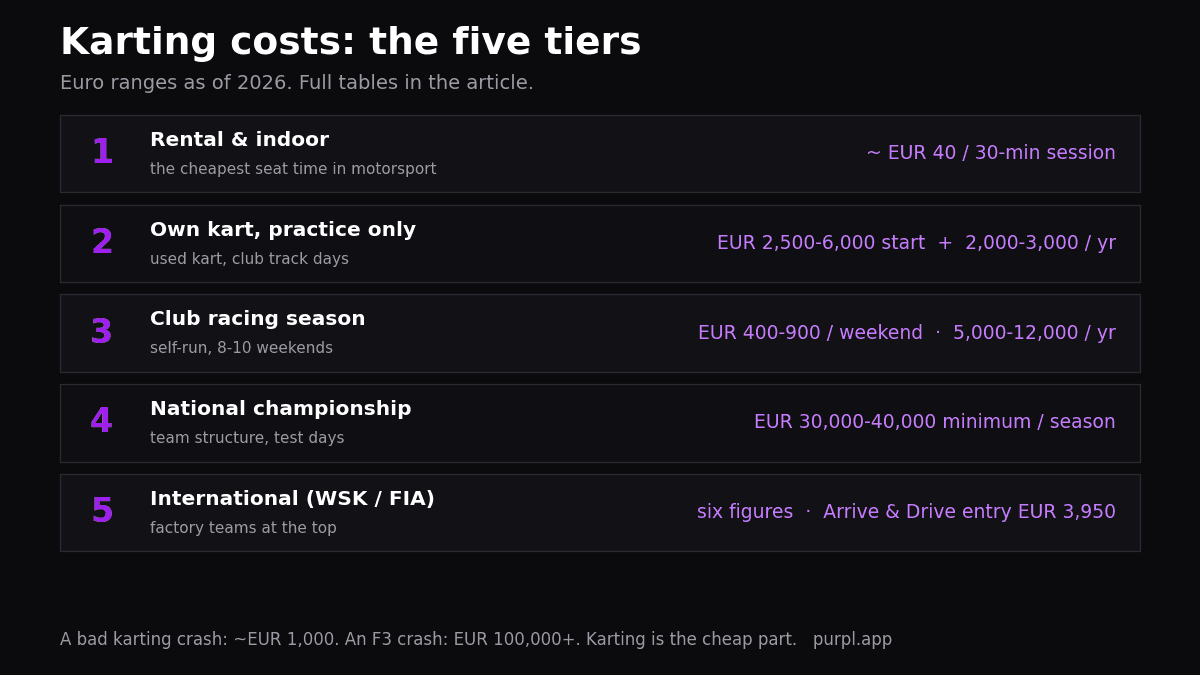
So here are the real numbers. The cost of kart racing in 2026 runs from €40 for one rental session to six figures for an international season, and everything in between sorts into five tiers.
One tier, one table, real euro ranges. And if the question comes from your kid, read this alongside my guide for karting parents before anyone signs anything.
Five tiers, one honest budget each
Rental karting sits at the bottom. Then your own kart for practice days, then club racing, then a national championship, and at the very top the international grids where the budgets stop being funny.
Every figure below is either a published budget, a championship price list, or plain arithmetic, and wherever it's arithmetic I'll say so out loud. Nothing is plucked from the air.
Climbing those tiers in order is the whole sport, and the map for the climb lives in how to get into kart racing. This page prices it.
Tier 1: rental karting
A 30-minute indoor session costs around €40. That's the whole bill.
Why so cheap? No kart of your own, no mechanic, no data system, no fresh tyres, no race engine waiting for a rebuild. Rental karting costs a fraction of professional karting for exactly that reason.
It's also the right first test. If the kid stops asking to go back after a few visits, you've answered the whole karting question for €40 and saved yourself a trailer.
As of 2026, here's the arithmetic.
| Item | Typical cost (EUR, as of 2026) | Notes |
|---|---|---|
| Indoor rental session, 30 minutes | around €40 | Kart and track time included; pay, drive, go home |
| One session a month for a year | about €480 | Arithmetic: 12 x €40 |
| One session a week for a year | about €2,080 | Arithmetic: 52 x €40 |
Look at that last row. A weekly habit costs roughly as much over a year as running your own kart, which is exactly where tier two starts making sense.
Tier 2: your own kart, practice only
This is where karting becomes a sport instead of an outing. A used 125cc kart, a trolley, a trailer for towing it, a toolbox, and gear with your name in the helmet.
The best public budget at this level comes from GoToTheGrid's owner-driver budget breakdown, built around roughly 22 practice days a year. Their ranges fill the table below, current as of 2026.
| Item | Typical range (EUR, as of 2026) | Notes |
|---|---|---|
| Used 125cc kart | €1,500-3,000 | The heart of the package |
| Kart trolley | €100-400 | New or used |
| Used trailer | €300-1,000 | Gets kart and gear to the track |
| Tools | €200-300 | Sockets, sprocket tools, pressure gauge and the rest |
| Driver gear | €400-1,000 | Helmet, suit, gloves, boots, rib protector |
| Startup total | €2,500-6,000 | One-off |
| Racing licence | €100-180 per year | Renewed annually |
| Track fees | €200-400 per year | Covers roughly 22 practice days |
| Consumables | €400-800 per year | Fuel, oil, chains, brake pads |
| Tyres | €600-800 per year | Three to four sets |
| Engine rebuilds | about €250 per top-end | Roughly every 25 running hours |
| Annual running total | €2,000-3,000 | Roughly €70 per driving hour |
Two things stand out. The startup package is a one-off, but the running costs come back every season, whether the season went well or not.
And by GoToTheGrid's count those 22 days work out near €70 per driving hour. Cheap seat time. On your own chassis, on your own schedule.
Class choice bends these numbers, mostly through engine life and tyre wear, and karting classes explained covers which class fits which wallet.
Tier 3: a club racing season
Now add race entries, and the tyre bill changes character. Fresh rubber, every round.
KartClass published a line-by-line club race weekend budget, in US dollars, so the euro column below is an approximate conversion as of 2026. Treat the euro figures as ballpark. The structure is the lesson.
| Item | Approximate cost (EUR, as of 2026) | KartClass figure (USD) |
|---|---|---|
| Practice and race entry | €30-90 | $30-100 |
| New tyre set | €200-270 | $220-290 |
| Two-stroke oil | €40-65 | $45-70 |
| Race engine across the weekend | €370-690 | $400-750 |
| Mechanic per day (optional at club level) | €185-370 | $200-400 |
| Self-run weekend total | roughly €400-900 | Without hired help |
Run the weekend yourself and it lands roughly €400-900. Hire a mechanic and it climbs past €1,000 fast.
The mechanic line says optional because at club level it really is. Doing your own spanner work keeps a weekend near the bottom of that range.
The season total is plain arithmetic. Eight to ten weekends at €400-900 each makes €3,200-9,000, and you still practise between rounds, so the tier-two running costs stay in the budget too.
Call it €5,000-12,000 for a self-run club season. What each of those weekends actually involves, hour by hour, is in the kart race weekend checklist.
Tier 4: a national championship
Here the numbers stop being hobby money. Giovanni Minardi put a figure on it in Vroomkart's budgeting piece.
A serious national championship season starts around €30,000-40,000, minimum, with test days included. As of 2026 that's the floor, not the average.
| Item | Typical range (EUR, as of 2026) | Notes |
|---|---|---|
| Full national championship season, test days included | €30,000-40,000 minimum | Giovanni Minardi's floor figure, via Vroomkart |
| Beyond the floor | open ended | Extra testing, crash repairs, travel and hotels |
Minardi's advice next to that figure is the part to keep. Don't overspend in karting, because the car ladder above it gets far more expensive and the budget has to survive the move from karting to car racing.
The gap between tier three and tier four is the sport's real filter. Plenty of quick drivers stop right here, not for lack of pace, but for lack of budget.
Spend everything on a kart trophy and the trophy is where the story ends. Plan the climb.
Tier 5: international racing
The honest number here comes with a date on it. A Reuters survey once put a European championship karting season near $200,000, and that was in 2010, with costs rising since. Dated, but honest.
Then 2026 brought a counterweight. The FIA's new Arrive & Drive championships cost €3,950 all-in per continental championship. That price, announced through Vroomkart's coverage, includes kart, engine, slick tyres, fuel, trolley and the paddock tent.
Both belong in one table, as of 2026.
| Item | Cost (as of 2026) | Notes |
|---|---|---|
| Traditional European championship season | around $200,000 | Reuters survey figure from 2010; costs have risen since |
| FIA Karting Arrive & Drive, one continental championship | €3,950 all-inclusive | Kart, engine, slick tyres, fuel, trolley and paddock tent for the weekend |
One path costs a house. The other costs less than a self-run club season, because the federation supplies kart, engine and tyres, and the driver just turns up with a helmet.
That €3,950 cap is the governing body's own attempt to lower the entry cost of international racing. Watch it.
The crash bill nobody budgets
Every table above misses one line. Crash damage.
A bad karting crash costs maybe €1,000. An axle, a spindle, sometimes the frame.
I raced Formula 3 and Formula 2, where the speeds pass 280 km/h and one crash can bill €100,000-150,000. Sponsors don't cover that.
For a family on a tight budget, one bill like that is the difference between racing next season and stopping forever.
Now read the tier tables again with that in mind, because the lesson flips completely: karting, the expensive hobby, is the cheap part of motorsport.
That's not an insult. It's the whole point: you make your mistakes and learn your craft here, at €1,000 a crash instead of €150,000.
And every step up the ladder costs more than the one before, so a step up has to be earned by results, not bought by impatience. Results first, then the chequebook.
How to spend it well
The families who make this work share one habit. They arrange enough budget for the full racing programme before the season starts, plus a margin on top for the extra track time that always turns out to matter.
Not for a shinier chassis. For laps.
Here's my opinion, and I'll defend it in any paddock. A full season at a cheaper tier beats half a season one tier up, every single time, in results and in what the driver learns.
And data is the cheapest lap time money buys. A logger and twenty honest minutes after each session find tenths that no engine bill can. Start with my karting telemetry guide, then build the routine from how to analyze kart racing data: one change at a time.
Most of the expensive habits in karting are ordinary beginner karting mistakes wearing a price tag. Buying grip instead of practising. Changing the kart instead of the driver.
And keep an eye on the Arrive & Drive route. As of 2026, €3,950 for an international championship rewrites what "can't afford it" means.
FAQ
How much does it cost to start karting?
About €40, because starting should mean a rental session, not a purchase. Do it five or six times first. Cheap data.
When you're ready to own, the startup package runs €2,500-6,000 as of 2026. Kart, trolley, trailer, tools and gear.
Is karting expensive?
Against other motorsport, no. Practice-level karting works out near €70 per driving hour, and a bad crash costs about €1,000 instead of six figures.
Against most family hobbies, yes. The fix is picking the tier that fits the budget, then spending inside it on track time first.
How much is a racing kart?
A used 125cc kart in raceable condition costs €1,500-3,000 as of 2026, per GoToTheGrid's budget research. New ones cost more and matter less.
Budget for the package, not the kart. Trolley, trailer, tools and driver gear lift the real startup bill to €2,500-6,000.
Can karting be done on a budget?
Yes, if the budget picks the tier instead of pride picking it. Rental karting costs €40 a go, and an owner-driver practice year runs €2,000-3,000 once the kart is bought. Pride costs extra.
And as of 2026 even the top has a budget door. The FIA's €3,950 Arrive & Drive championships exist precisely for drivers with talent and without a trust fund.
Alessio Lorandi started karting at six and won the 2013 CIK-FIA Karting World Championship. He raced through Formula 3, GP3 and Formula 2 before founding Purpl, an AI data coach for karting drivers.