10 Mistakes Beginner Karting Drivers Make (Visible in Their Data)
Every beginner makes the same ten karting mistakes, and every one of them leaves a fingerprint in the data. The list, the fixes, and where each one hides.
Beginners think their mistakes are unique. They're not, and that's the best news in this article.
The same karting mistakes beginners make have been made by every driver who's now fast, me very much included. Better still, each one leaves a fingerprint in the data, which means each one can be caught, named and fixed instead of slowly grown out of.
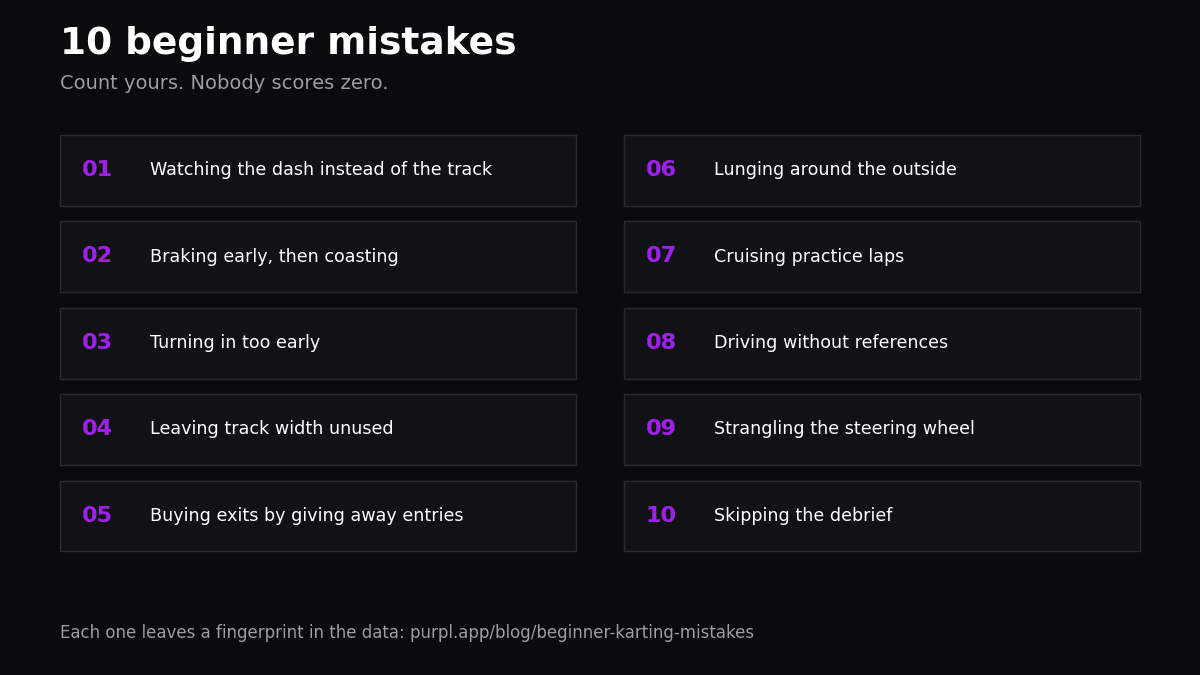
Here are the ten, with the trace that betrays each one.
None of them need talent to fix. They need a name, a trace and two honest sessions, which is exactly what this list is for.
1. Watching the dash instead of the track
The lap time flashes, the brain starts doing maths, and the lap dies at the next corner. The most common mistake in karting, at every level, and the data twin of it is never opening the laptop where the numbers actually belong.
From the seat it feels productive, like checking progress, but the glance costs attention, and the next corner of this lap needs every bit of it. The number will still be there in the pits.
In the data: laps that fall apart right after personal-best sectors. The fix is a boring screen and an evening habit, per the karting telemetry guide.
2. Braking early, then coasting
The beginner brake is a long, polite squeeze that finishes far before the corner. The metres between brake release and turn-in are pure donation, and slow corners punish them hardest.
Coasting feels safe because nothing dramatic happens. That's exactly the problem. So run a drill: pick one corner, brake a kart-length later than feels comfortable, keep the pressure honest all the way down, and see what the lap says.
In the data: a shallow braking wall with a flat shelf before the valley. The cure is building braking technique from the stop backwards.
3. Turning in too early
Early turn-in feels fast and ruins everything after. The kart clips an early apex, runs out of road on exit, and the throttle waits while the steering unwinds.
The seat lies here. Waiting that extra beat feels like losing time, which is why nobody waits, so hold the kart straight a beat longer and watch the exit open up.
In the data: exit slopes that start late, and corner radius tightening at the kerb. The geometry lives in the racing line guide.
4. Leaving track width unused
Half a metre of entry width here, the exit kerb never touched there, for no reason beyond habit. Track you don't use is radius you don't get, and radius is speed.
On the onboard it looks deliberate, like a chosen line. It isn't. It's a comfort margin that crept in on lap one and never left.
In the data: GPS lines that float inside the white lines lap after lap. Audit it honestly: could you have used more road, even when it felt on the limit? The answer is usually yes.
5. Buying exits by giving away entries
Beginners get told to brake early and get on the gas early, and it's comfortable advice that caps progress. Easy entries mean no advantage, and the habit hardens.
The tell is how relaxed the entry feels. Real entry speed feels slightly wrong at first, like arriving too fast at a problem, and that slightly-wrong feeling is the price of the tenths. It fades with repetition.
In the data: entry speeds far below the reference with exits that are merely equal. The full argument, and where exit priority genuinely belongs, is in corner exit speed.
6. Lunging around the outside
The instinct comes from television, and karting charges full price for it: positions donated at the exit, sometimes several at once.
The move feels heroic for about two seconds, then the inside kart squeezes, the grip runs out, and the exit charges you for the detour. Patience here isn't a personality trait, it's arithmetic.
In the data: race laps with mysterious half-second losses at the same corners where the "opportunity" appeared. The arithmetic that fixes it is in overtaking in karting.
7. Cruising practice laps
Twenty laps at ninety percent teach almost nothing, however good they feel. Lap quality multiplies lap value, and a tank of cruising is a tank of fuel converted into habit, not skill.
In the data: a beautiful, tight spread sitting seconds off the pace. Push deliberately, accept the overpushing mistakes, and the limit arrives much sooner.
Ninety percent has a feel you can learn to catch: breathing easy, hands quiet, brain wandering to lunch. If the session feels comfortable, it's probably teaching comfort.
8. Driving without references
No braking markers, no turn-in points, just vibes. Every lap becomes a fresh improvisation, and improvisation doesn't repeat.
Driving without them has a tell you can feel: every corner arrives as a mild surprise. Confidence can't grow on surprises. It grows on markers that sit in the same place every lap.
In the data: braking points scattered over ten metres, lap times scattered with them. The fix costs nothing: pick one physical reference per corner and hit it, the consistency engine from lap consistency.
9. Strangling the steering wheel
Death grip, busy hands, constant corrections. The front tyres get renegotiated mid-corner and answer with scrub.
You can feel this one in your forearms after a session. Pumped arms mean a strangled wheel. Light hands let the kart finish what the first input started, and the front grip comes back on its own.
In the data: sawteeth on the lateral-G curve and lines that never stack. The count-to-one drill in steering technique quiets it in a few sessions.
10. Skipping the debrief
The session ends, the kart goes on the trolley, the lessons evaporate. Memory rewrites the day by dinner, and next session starts from scratch.
The fix is almost insultingly small. Three sentences before the engine cools: what worked, what didn't, what to try first next time. So the next session starts with a plan instead of a shrug.
In the data: nothing, because the data never got opened, which is the fingerprint. Fifteen minutes with the debrief template turns sessions into a season.
Score yourself, then pick one
Count how many are yours. A beginner honestly scoring under five is rare, and nobody scores zero, because several of these stay tempting forever.
Be honest. Nobody's grading you.
Then resist the urge to fix everything. Pick the one costing the most, usually number 2 or number 8, and make it the only project for two sessions. Let the data confirm the fix before you move down the list, the working loop from how to analyze kart racing data.
One change at a time is the whole method.
Scoring a teammate silently works too, because the list reads very differently when it's about someone else's laps, and the difference between the two scores is the honesty gap. And expect a relapse or two: old habits reapply for the job the first time a session goes badly, so the score is worth re-running once a month.
The community lists cover the surface well, KartClass's things to avoid among them, and the weekend-level errors live in Blayze's race prep guide. The data layer is what turns any list into a checklist you can actually verify.
FAQ
What's the most common beginner mistake in karting?
Braking too early and coasting to the corner. It feels safe, it looks tidy, and it quietly costs more time than any other habit. The trace shows it in one session, which is why it's also the most fixable.
Nothing about it feels wrong from the seat, which is why it survives so long. The trace has no such politeness.
How long do these mistakes take to fix?
One at a time, most yield in two or three deliberate sessions, because the data makes progress visible immediately. All ten at once never works; that's just mistake number eleven.
The sticky ones are numbers 1 and 9, because they live in the eyes and the hands rather than in a plan you can write down. Expect those to creep back under race pressure now and then. They do for everyone.
Do I need a data logger to fix beginner mistakes?
No, but it collapses the timeline. Every mistake here was fixable before loggers existed, slowly, by feel and coaching. The trace just replaces months of guessing with an evening of looking, the case made across the getting started guide.
Start with whatever timing you already have. Even plain sector times point at the expensive corners, and the habit of looking is the real upgrade.
Are these mistakes different in rental karts?
Same list, gentler consequences. Rental karting is actually the perfect place to fix numbers 2, 8 and 9, because the karts forgive experiments and the timesheet still tells the truth. Treat rental sessions as training, not just fun.
The only adjustment is patience with the kart itself. Rental engines vary, so judge yourself on consistency and line rather than on raw lap time against whoever drew the faster kart.
Alessio Lorandi started karting at six and won the 2013 CIK-FIA Karting World Championship. He raced through Formula 3, GP3 and Formula 2 before founding Purpl, an AI data coach for karting drivers.