Race Weekend Preparation: A Karting Checklist (Data Prep Included)
Weekends are won on Thursday night. The full race weekend checklist for karting: kart, gear, driver and data, with a printable PDF for the toolbox.
Race weekends are won on Thursday night.
Not in qualifying. Not off the start. They're won when the gear bag gets packed, the logger gets charged and the chassis gets checked while everyone else is still loading the van.
Every weekend that goes wrong donates tenths to chaos. A flat logger battery here, a stretched chain there, a driver who slept five hours, skipped breakfast and hasn't touched water since the motorway services.
None of it shows up as one big failure. It leaks.
So this is the race weekend checklist karting drivers actually need: kart, gear, driver and data, in the order the weekend burns through them, Thursday night to Sunday's last download. There's a printable PDF at the end. Print it and stop trusting your memory.
The night before is part of the race
Let me ask you a question. If you're not disciplined enough to pack your gear the night before, do you really expect to show up and win on race day?
Same if you don't analyse your data and onboard video every session. Same if you skip the feedback, the setup talk, the water, the notes after you drive. How you do one thing is how you do everything.
The marines have a definition of discipline I'll borrow once: doing what needs to be done whether you feel like it or not. And when nobody's watching.
Thursday night is exactly that. Nobody's watching.
The block itself is short. Suit, helmet, gloves, boots, rib protector and wet-weather gear, all in the bag and by the door. Tools and spares loaded, fuel sorted, licence and entry paperwork where you can find them.
Then the data kit, because it fails quietly. Logger charged overnight. Memory card cleared, with last weekend's files backed up first.
A logger that dies in session two costs you the whole day's baseline, and you only discover it after the session it killed. Charging habits are cheap insurance, and the full routine is in data logger battery care.
If you're building the kit list from zero, KartClass's season prep guide goes deeper on gear and training.
And then sleep, the item nobody writes down. Some drivers get eight hours or more the night before a race, while others manage five or six because the tension won't let them switch off.
That gap shows before anyone reaches the track.
Practice day runs on two passes
Friday has one job: build a baseline you can trust. That takes two passes, one mechanical and one digital, and most paddocks only run the first.
The mechanical pass covers the checks that decide whether the weekend means anything, because no setup conversation survives a bent axle or a dragging chain. These are the ones worth stealing:
- Front toe. Too much toe drags you down the straights, so set it before anyone discusses grip.
- Steering angle, left against right. The kart should steer the same amount both ways.
- Pinion and sprocket alignment. Even 1mm out creates chain tension on its own.
- Axle and rear rims. A bent axle or rim brings vibration, carburation that never settles, and in the worst case a crankshaft put at risk long before anything feels wrong.
- Chain tension. Too tight and it drags the moment lateral and longitudinal G combine; too stretched and you lose power. Fit a new chain the session before qualifying.
TKART's pre-weekend chassis check walks the same ground from the mechanic's side, frame and front-end angles included. Use both lists. Bolts loosen between weekends whether you watched them or not.
If those adjustments are new to you, kart setup basics explains what each one does before you start moving them.
The digital pass is shorter and skipped more often. Power the logger and confirm it actually records, not just that it turns on.
A transponder zip-tied in the wrong place, a GPS antenna hidden under bodywork, a memory card quietly full: any of them can erase a day of evidence. Friday is when you catch them.
Check the lap timer reads the line. Found on Friday, a timing fault is a two-minute fix; found in qualifying, it's a lost session. Lap timer not reading laps covers the usual suspects.
Then log a clean baseline run and write the session sheet: pressures, sprocket, conditions, best lap, one honest note about what the kart did. The habit comes from the data starter sheet, and it costs two minutes a run.
Friday's data is Sunday's reference. Treat it that way.
Race day and the driver's window
The kart has a performance window. So do you. The driver's version is focus, hydration, sleep, mental clarity, mood.
A driver outside that window gives away time no setup change can buy back, and unlike a carburation problem, nobody in the tent can see it on a screen.
During race days I would talk to nobody except my mechanic. Game face on. Anyone who tried a joke got the same answer: "come on, make serious".
That bubble wasn't rudeness. It was concentration, protected on purpose.
You don't have to copy the silence. You do have to decide, before the day starts, what your version of the bubble looks like and who's allowed inside it.
Hydration is the most measurable part of the window. Dehydration starts at 1 to 2% of body weight, which is roughly half a litre already missing before you feel anything at all. If you wait until you're thirsty, you're already there.
The signs are ordinary enough to ignore. Dry mouth, dizziness after a session, headaches, cramps arriving early, dark urine. And focus drops first, before any of those, which is exactly why drivers write it off as "an off day".
Food follows the same logic. Light, early, boring. Heavy lunches and finals don't mix.
Between sessions, the checklist earns its keep. Everything on the kart can be perfect except one parameter, say an EGT running 100°C below target, and you leave tenths on the table for nothing.
Without a ready checklist you're left clueless, wondering what went wrong instead of finding the problem at the source. "Numbers have got no emotions."
So after every session, scan every channel against its target: two minutes with the download before anyone voices an opinion in the tent. If reading those channels is new territory, start with the karting telemetry guide.
Log tyre pressures cold and hot, every run, no exceptions. The method is in kart tire pressure; race day is where it pays, because grip moves by the hour and the rubber keeps coming down.
TKART's champion-advice piece on approaching a kart race lands in the same place this checklist does: procedures, repeated, every weekend. Procedure beats mood.
The data prep most checklists forget
Generic karting race preparation lists stop at the kart and the gear bag, as if the weekend ends when the engine does. The data side has its own short list, and it's the part that decides whether the weekend teaches you anything or just costs you money.
Before the first session: logger battery full, memory clear, GPS locked, every sensor showing a number that makes sense. A water temperature of 11°C in July is a wiring question, not a weather report. Kart sensors explained covers what each channel looks like when it's healthy.
After every session: the short debrief. Feelings first, one verdict, one change. The full routine and its printable sheet live in the karting debrief template.
End of day: download everything, back up the card, plug in the chargers. Ten minutes that protect the whole weekend's evidence. Then bed.
None of this is glamorous. That's rather the point. Most of the classic beginner karting mistakes are preparation failures wearing race-day clothes, from forgotten wet tyres to setups changed in a panic between heats.
The printable race weekend checklist
Everything above compresses onto one A4 page. Three blocks.
Night before. Gear bag packed, kart and spares loaded, logger charged, memory cleared, paperwork found, water in the cooler, lights out at a sensible hour.
Every session. Pressures logged cold and hot, channel scan against targets, debrief sheet filled, one change chosen.
After the day. Data downloaded and backed up, everything on charge, sheets in the folder, tomorrow's plan in one sentence.
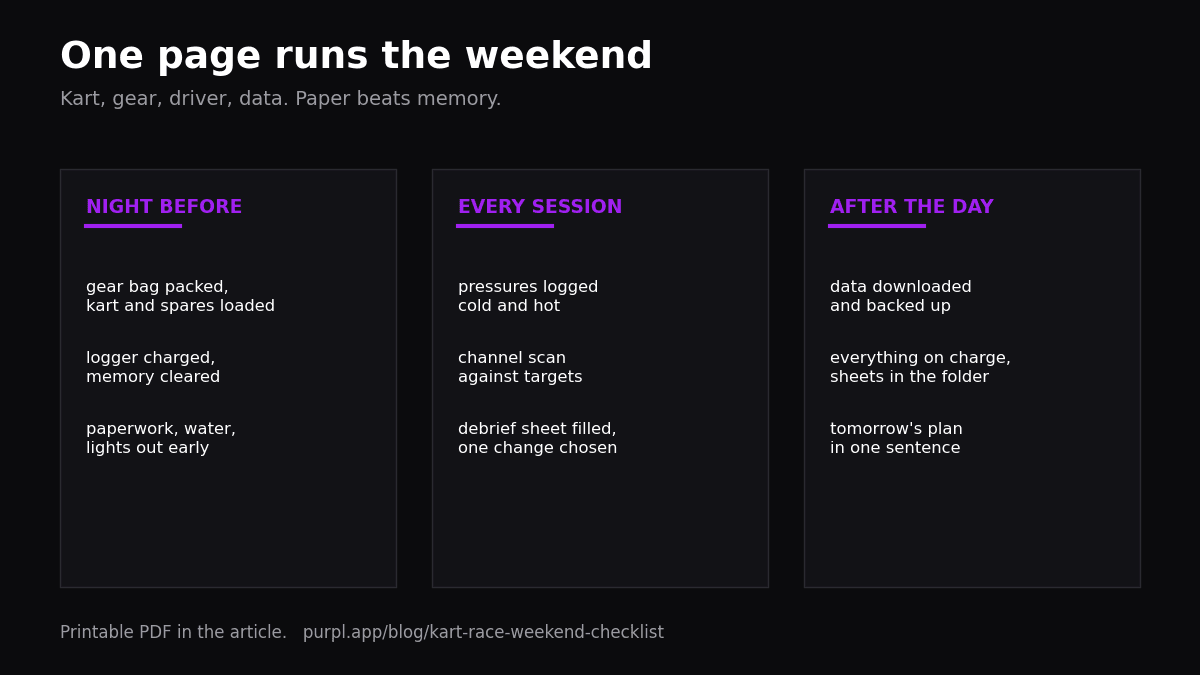
Download the printable race weekend checklist (PDF). Free, no email wall, deliberately boring. Print five, clip them to the board, and run the weekend off paper instead of memory.
A checklist doesn't make you fast. It stops you being slow for reasons that were preventable on Thursday.
And here's the opinion I'll defend in any paddock. A mid-pack driver who runs this list beats a faster one who improvises, most Sundays, because the improviser spends race day solving problems the list catches on Thursday.
Chaos is the most expensive setup mistake in karting. It's also the only one that's free to fix.
Print it. Run it. Boring wins.
FAQ
What should I bring to a kart race?
Driving gear first: suit, karting-approved helmet, gloves, boots, rib and neck protection, plus full wet-weather gear. Then kart spares, tools, fuel and oil, paperwork, food and water, and the data kit: charged logger, cleared memory, laptop, cables, spare batteries.
Pack it the night before, every time. The forgotten item is always the one with no spare at the track.
How do I prepare for a kart race weekend?
Work backwards from Sunday. Night before: gear, kart checks, charged electronics, proper sleep. Practice day: the mechanical pass, a verified lap timer, a logged baseline.
Race day: protect the driver's window, scan the data between sessions, change one thing at a time. The printable checklist above holds the whole sequence.
What should I check on my kart before racing?
Front toe, steering angle left against right, pinion and sprocket alignment, axle and rims for straightness, chain condition and tension. Then the bolts, every weekend, because vibration undoes them quietly.
One detail worth repeating: fit the new chain the session before qualifying, not five minutes before it.
What data should I check between sessions at a race?
One scan of every channel against its target: RPM range, temperatures, pressures, lap times. You're hunting the one parameter that drifted while everything else stayed perfect, the kind of miss that costs tenths all afternoon without ever announcing itself.
Then the short debrief: one verdict, one change. Save the deep analysis for the evening, because race days reward speed over depth.
Alessio Lorandi started karting at six and won the 2013 CIK-FIA Karting World Championship. He raced through Formula 3, GP3 and Formula 2 before founding Purpl, an AI data coach for karting drivers.