Kart Gearing: How to Choose Sprockets Using RPM Data
Stop guessing sprockets. The limiter-metres method, the minimum-RPM floor check, and the verdict table that converts any RPM trace into a tooth count.

Gearing is the only gear-shifting most karts ever do. And it happens in the tent, with a chain breaker.
The kart gear ratio question, which sprocket today, gets answered three ways in most paddocks. Copy the fast guy, ask the engine tuner, or guess.
There's a fourth way, and it's better than all three. Read your own RPM trace, and let it name the teeth.
Here's the method, including the verdict table that converts any trace into a sprocket decision you can defend when the engine tuner raises an eyebrow.
Sixty seconds of gearing mechanics
The ratio is rear sprocket teeth divided by engine sprocket teeth. More rear teeth makes the gearing shorter: harder acceleration, higher revs, lower top speed. Fewer rear teeth makes it taller: softer acceleration, lower revs, more speed at the end of the straight.
One tooth on the rear is the standard adjustment step. And the trade never sleeps: everything you gain out of corners you spend at the end of straights. The track layout decides the right balance.
One practical note while the chain breaker is out. Changing rear teeth changes the chain run. A bigger sprocket usually wants a longer chain or the axle adjusted, and a smaller one the reverse.
Budget the time, and check alignment every single time the sprocket comes off. A crooked sprocket scrubs speed down the whole straight, eats chains, and quietly cancels the gain you geared for. None of that shows up in a calculator, but all of it shows up in the lap.
The mechanical primer lives in KartClass's gear ratio explainer, and chart-and-calculator references like GoKartGuide's cover the arithmetic.
The arithmetic was never the hard part. Knowing which way to move, today, on this track, is. That's the RPM trace's job.
Choosing a kart gear ratio with RPM data
Two readings decide almost every sprocket. Your logger records both for free.
Limiter metres. In limiter classes, the question isn't whether you touch the limiter but for how many metres you sit on it. Hammering the limiter long before the braking point means the gearing is too short: you've spent your revs and the straight's end is a parade.
Barely brushing it, or never reaching it, means too tall, and the whole straight was soft. Monitor the metres, compare against your notes from past visits, and the sprocket direction names itself.
The minimum-RPM floor. The slow-corner floor decides the exits. As a frame, Mini and OKJ engines want their floors somewhere in the 7,000 to 8,000 range.
But the spread is the lesson. A scrappy driver struggles to keep 7,000 where a fast driver holds 8,000 on the same sprocket. Because the fast driver's rounder, wider line keeps the revs alive.
The floor is driving-dependent, which is exactly why your own trace beats anyone's chart.
That coupling produces the rule of thumb worth memorising. The better the driver, the longer the sprocket he can run, trading acceleration he doesn't need for top speed everyone wants.
The sprocket verdict table
Here's the whole method as a lookup. Find your trace's symptom, read across.
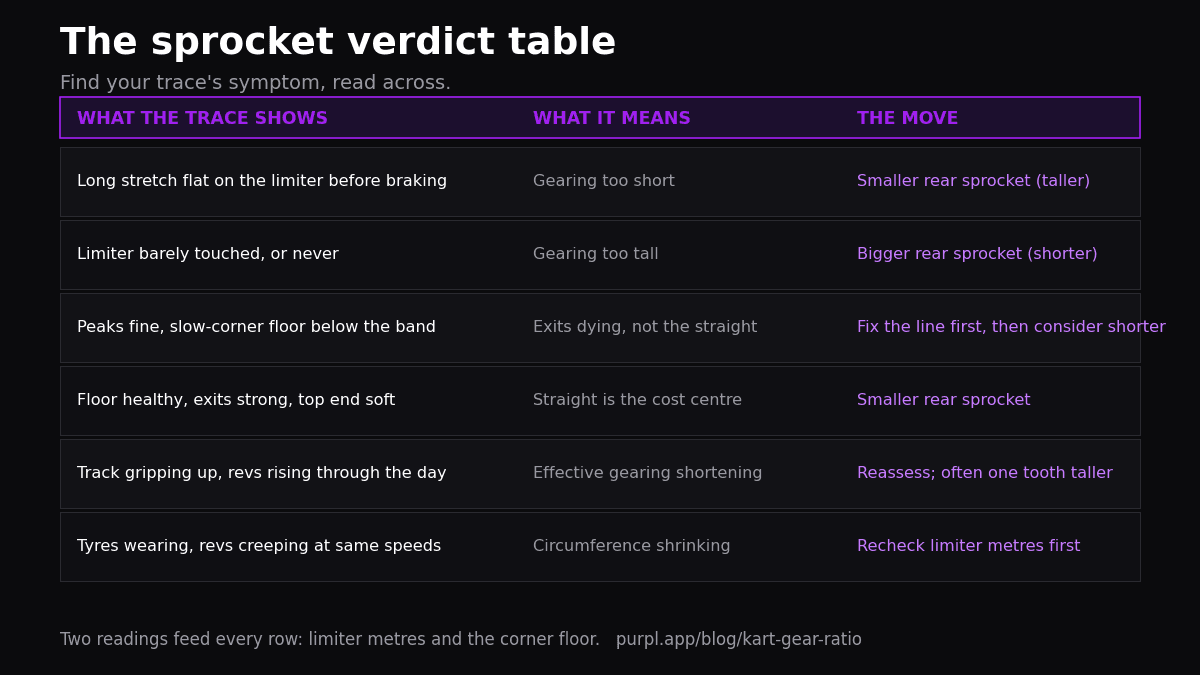
| What the trace shows | What it means | The move |
|---|---|---|
| Long stretch flat on the limiter before braking | Gearing too short | Smaller rear sprocket (taller) |
| Limiter barely touched, or never | Gearing too tall | Bigger rear sprocket (shorter) |
| Peaks fine, slow-corner floor below the band | Exits dying, not the straight | Fix the line first, then consider shorter |
| Floor healthy, exits strong, top end soft | Straight is the cost centre | Smaller rear sprocket |
| Track gripping up through the day, revs rising | Effective gearing shortening | Reassess; often one tooth taller |
| Tyres wearing, revs creeping up at same speeds | Circumference shrinking | Recheck limiter metres before reacting |
Two readings feed every row: limiter metres and the corner floor, both from kart RPM data. The table just removes the debate. Plain and simple.
Want to see it earn its keep? Walk it through a made-up morning.
First session ends and the trace comes out. Peaks look fine, but the kart sits flat on the limiter for a long stretch before the braking point. That's row one: too short.
So you go one rear tooth smaller and run again. Taller now.
Second session, the limiter arrives just before the braking point, the straight finally pulls all the way through, and the kart feels like it grew an engine. But check the floors before you celebrate.
If the slow-corner floor dropped below the band, the tooth you removed was covering for an exit problem. Row three is suddenly your row. Fix the line before touching the chain again.
Floors still healthy? Then the tooth is a keeper, and the trace just settled, in one printed line, an argument the tent would have chewed on until the engines went quiet.
Write the verdict down. One tooth, one session, one answer.
The driving-versus-gearing trap
The third row deserves its own warning. It's where most wrong sprockets come from.
A low corner floor has two possible authors: gearing too tall, or a corner driven too stopped. Change the sprocket for a driving problem and you've taxed the whole straight to subsidise one bad corner.
The honest check is the line. If more track and a rounder arc would keep the revs up, that's the move. And it costs zero teeth.
The corner-shape side of that decision lives in karting corner types, and the economics of what a strong exit is actually worth sit in corner exit speed.
Gearing across the day and the race
The right sprocket is a moving target. Because the track is.
Grip builds through a race day, minimum speeds rise, and the same sprocket effectively shortens. By the final you're hitting the limiter earlier than you did at nine in the morning.
The trace shows the drift lap by lap, which is why the peak-RPM column belongs in your session sheet every run, the habit from kart setup basics.
How do you log it without extra work? Two columns in the sheet. Easy peasy.
After every session, write the peak RPM and the limiter metres next to the run number, with the sprocket fitted for that run and the tyres it ran on.
The habit starts at the install, the wiring side covered in kart data logger installation. And if you'd rather have a spreadsheet than scribbles, export the telemetry to CSV and let the sheet build itself while you're still pushing the kart onto the trolley.
Why bother? Because next time you arrive at this track, the first sprocket isn't a guess. It's last visit's verdict, waiting to be corrected for today's grip.
And the race itself has a shape: short gearing buys the opening laps on cold tyres; tall gearing collects at the end when grip arrives. Nobody gets to be fastest at every stage, the full trade covered in the race-shape section of the RPM article.
The verdict table tells you what the trace said. The calendar tells you which stage of the weekend to gear for.
FAQ
What gear ratio should my kart run?
Whatever makes your trace healthy at this track, today: limiter metres reasonable, corner floors above the band, exits alive. Baseline from your class's standard for the circuit, then move by the table. A ratio number without a trace behind it is just someone else's track day.
Ask around for a starting point, sure. Baselines get shared freely in most paddocks, because the baseline was never the secret. The trace you read afterwards is.
How much difference does one tooth make?
Enough to see immediately in the trace: peak revs move, the limiter metres change, and the slow-corner floors shift. That visibility is the point, one tooth and one session gives a clean verdict, two changes at once gives none.
Resist the two-tooth jump when the trace looks ugly. The bigger the jump, the muddier the verdict, and you'll spend an extra session working out which half of the change did what, on a track that moved anyway.
Why does the fast kid run a smaller sprocket than me?
Because his driving keeps the revs alive where yours drops them. Longer gearing rewards the rounder, wider, cleaner corner, so the sprocket gap is usually a driving gap wearing a chain. Close the corner-floor difference and the tooth difference follows.
So copy his line before you copy his sprocket. Fit his gearing without his corner speed and you collect the worst of both worlds: exits that die early and a straight that never quite arrives. The teeth come last.
Do I regear for rain?
Generally shorter, because wet corner speeds drop and the engine needs help getting off them. But read it like any other day. The floors and the limiter metres in the wet sessions tell you how much, per the wet methods in wet weather data.
And keep the wet rows separate in your sheet. Label them. A wet baseline from a past visit is gold, but only if you can find it again.
Alessio Lorandi started karting at six and won the 2013 CIK-FIA Karting World Championship. He raced through Formula 3, GP3 and Formula 2 before founding Purpl, an AI data coach for karting drivers.