Inside Rear Wheel Lift in a Kart: How Many Kilos Move
In a physics model of a KZ shifter the inside rear tyre falls from 49 kg standing to 11 kg at 1.5 g. A kart has no differential, so that unloading is how it turns.
How many kilos does the inside rear actually carry in a corner?
In the model I ran, a KZ shifter on an OTK chassis, the inside rear tyre carries about 49 kg standing still and about 11 kg at 1.5 g in a left-hand corner. The outside rear goes from 53 kg to 91 kg. Total lateral load transfer is about 57 kg. These are calculated and estimated numbers, not measurements of a real kart.
I keep saying "the model" for a reason. It is a physics model of one kart, with a 70 kg driver, 170.25 kg in total with the engine and gear. Nobody put scales under a kart at 1.5 g. So read every number here as what the maths says for those inputs, and as a direction for your own kart.
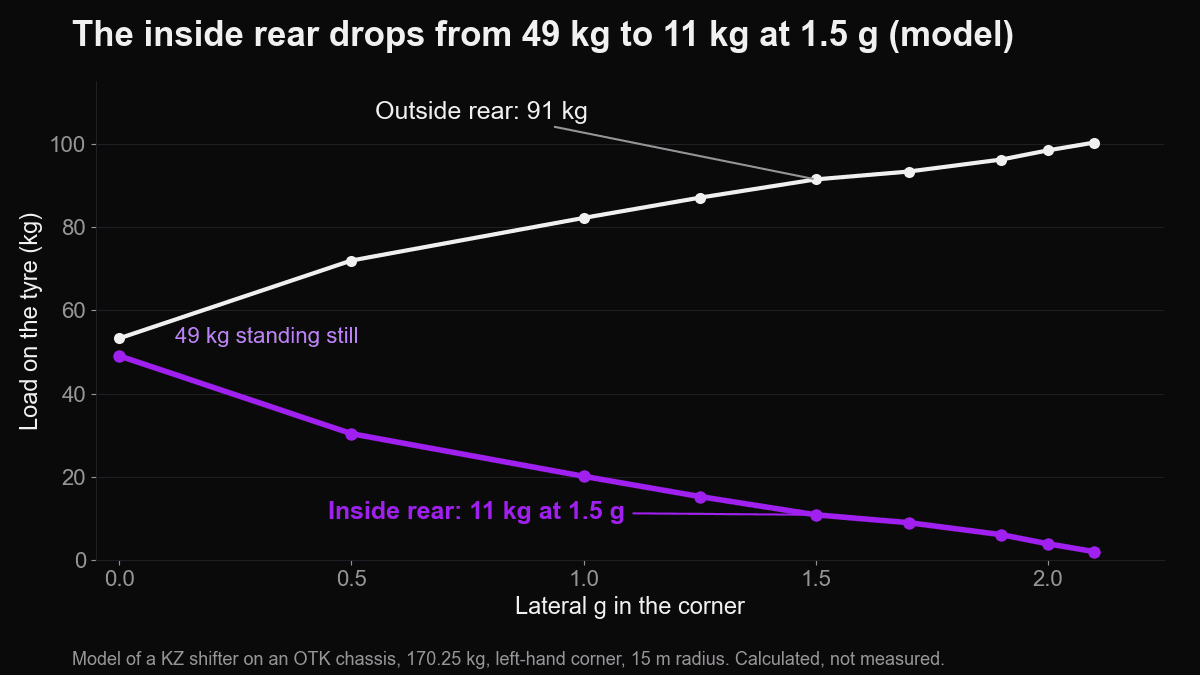
The purple line is the one that matters. It keeps falling as the corner gets faster, and it falls fastest early. Half a g takes it from 49 kg to 30 kg. Everything after that is slower, because the first kilos are the easy ones to move.
How much load moves onto each tyre at 1.0, 1.25 and 1.5 g?
Here are all four tyres in a left-hand corner, 15 m radius, same model. The standing column is the static corner weight. The other three columns are the load at that lateral g, estimated to two figures.
| Tyre | Standing | 1.0 g | 1.25 g | 1.5 g |
|---|---|---|---|---|
| Inside front (left) | 32 kg | 25 kg | 20 kg | 15 kg |
| Outside front (right) | 35 kg | 43 kg | 48 kg | 53 kg |
| Inside rear (left) | 49 kg | 20 kg | 15 kg | 11 kg |
| Outside rear (right) | 53 kg | 82 kg | 87 kg | 91 kg |
Total lateral load transfer is 38 kg at 1.0 g, 47 kg at 1.25 g and 57 kg at 1.5 g. That one is derived: mass times lateral g times centre of gravity height, divided by the track. The model puts the centre of gravity at about 250 mm, and that height is an estimate, so the transfer is only as good as that estimate.
Look at the rear pair at 1.5 g. 91 kg on the outside and 11 kg on the inside. That is eight times more on one tyre than the other, on the same axle.
A heavier kart does not change the story much. I raised the driver weight until the total was 175 kg, the KZ minimum, and the inside rear still came out at about 11 kg at 1.5 g. Turn direction does change it. The engine sits on the right, so in a right-hand corner the same 1.5 g leaves about 14 kg on the inside rear. The two directions are not mirror images.
Why can a kart not turn without the inside rear lifting?
Because there is no differential. I mean, think about it: in a corner the outside rear wheel has to cover a longer arc than the inside one. A car solves that with a differential. A kart has one solid axle, so both rear wheels turn at the same speed, always.
The model has a number for this. On a 15 m radius each rear tyre has to slip about 4.0 percent against the ground, unless the inside rear is unloaded. That is derived from the rear track and the radius, nothing else. On an 8 m hairpin radius it is about 7.4 percent. On 30 m it is about 2.0 percent, and on 60 m about 1.0 percent.
That is the mechanism. The axle wants to go straight, and a loaded inside tyre will not let the two wheels run at different speeds. Take the load off the inside tyre and it stops fighting the axle, and the kart can rotate on the outside rear. That is why the inside rear is not a detail in a kart. It is how the kart turns.
It also tells you where it matters. The mismatch is 7.4 percent in the hairpin and 1.0 percent in a long fast bend. So the inside rear costs you most in slow, tight corners, and that is where I tell drivers to chase it. In a fast corner there is not much to chase.
Does the model say the wheel really leaves the ground?
No, and I will not pretend it does. I swept the lateral g from 0 to 2.1 g. The inside rear air gap stays at 0 mm the whole way, and the load falls to about 2 kg at 2.1 g but never reaches zero. The tip-over threshold is 2.2 g for a left-hand corner, calculated.
So what the model gives you is the loading, and the loading is clear: the inside rear ends up carrying a fraction of what it carries standing still. The visible lift, the wheel that comes up even by a fraction, is not in these numbers. In a real kart it also depends on how the chassis and the axle flex. Treat 11 kg as "nearly unloaded", and do not read it as "in the air".
Why can you not lift the inside rear by going slower?
Because the unloading comes from lateral g, and lateral g comes from speed. Run the same 15 m corner at 0.5 g, about 31 km/h, and the inside rear still carries about 30 kg. At 1.5 g, about 53 km/h, it carries about 11 kg. The speeds are derived from the radius and the g, and the loads are estimated.
That matches what I say to drivers. Try lifting the inside rear wheel when you go slow into the corner and it will not happen. A driver who rolls the speed off to feel safe is taking away the thing that unloads the inside tyre. The speed the corner can hold is the speed that gives you the rotation.
It works the other way too. Get back on the gas too early and the rear wheels get their traction back and both go down. Then you have two loaded tyres on a solid axle, and the kart pushes. How to arrive at that corner, and what to do with your body and your hands, is a driving question. I answer it on senndit.com, in weight transfer in a kart: how rotation is actually generated.
What can you check on your own kart?
You will not see a wheel-lift number on the screen. What the data shows is the consequence: minimum corner speed, the shape of the lateral g trace and how early the throttle comes in all move with the load on that inside tyre. Read them together with the friction circle, and use seat position and the understeer and oversteer diagnosis to decide what to change first.
One change per session, and write down which. A stiffer seat lets the inside rear lift less, so it should show up in the minimum speed and the exit, not as a number of its own.