Who Owns Your Racing Data? Telemetry, Privacy and Fair Play
You generated every byte of your telemetry, so why can't you take it with you? My position on racing data ownership, portability and fair play.
Every byte of telemetry in your logger came from your hands, your braking points, your entry speed, your half-spin at turn three. You generated all of it. Every single byte.
So here's the question nobody in the paddock asks. When you leave a team, why can't you take that data with you?
Racing data ownership sounds like a topic for lawyers. It isn't. It decides whether years of your development stay yours, or sit on someone else's laptop, in a format you can't open, until a cleanup nobody mentions.
I have a clear position on this. And later in the piece I'll declare my own interest in it. Openly.
Who actually holds your data today
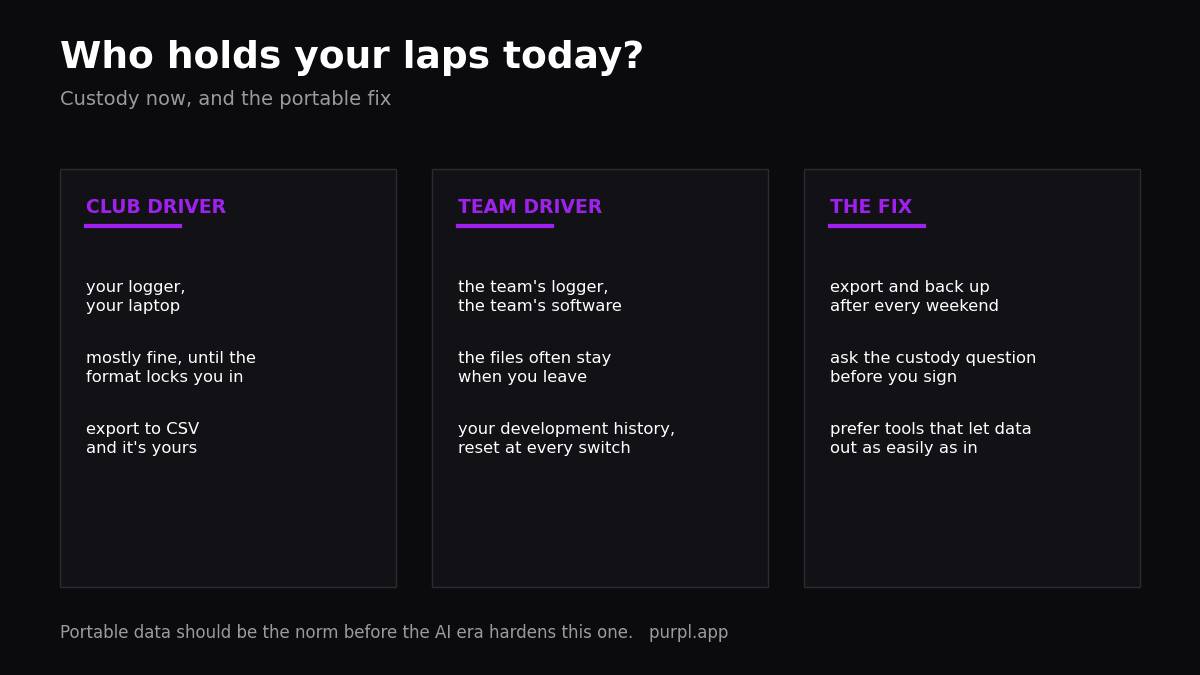
Start at club level, because that's where most of us live. You bought the logger, you download the sessions after every run, the files go home on your own laptop, and nobody else ever touches them. So far, so good.
Except the files usually open in one program only. It's common across the sport for each logger brand to store sessions in its own format, readable mainly by its own software. Your data is "yours", but it lives in a house with one door.
Nobody designed that as a trap. The analysis software simply grew up closed, brand by brand, and the formats hardened around it.
Try opening a five-year-old session file from a brand whose software has moved on since. Sometimes it works. Sometimes the archive is simply unreadable, and nobody decided that on purpose.
Team driver? Different picture.
The logger belongs to the team, the laptop belongs to the team, the software licence belongs to the team, and an engineer manages the files. When you leave, the folder with your name on it usually stays behind.
The higher you climb, the less of your own data you hold. Backwards, if you ask me.
I lived that curve myself. Across my Formula 3, GP3 and Formula 2 seasons the telemetry lived on team systems, run by team engineers, and I spent long hours beside them studying it. That was standard practice everywhere, and nobody questioned it, me included.
I'm not saying the teams were wrong. The structure was normal, and it still is. I'm saying nobody ever asked whose files those were, and the silence did the deciding.
Why it matters more than it sounds
Your data is your development history. References, baselines, the proof of how you progressed. Lose the files and you lose the record.
All of it.
Think about what a season of telemetry actually contains. Your braking references at every track you visited, the wet-weather baselines, the slow corners where you finally found two tenths between March and September.
Switch teams and leave that behind, and your learning resets. Not to zero, because your hands remember. But every reference you built in the data is gone, and the comparison work that took you whole seasons starts all over again from a blank screen.
And comparison is the whole game. Comparing your laps against a faster reference is the closest thing to a legal shortcut that karting has.
A comparison culture only works when files can move. Between drivers, between tools, between seasons. That's portability.
The whole loop in my data analysis routine assumes you can reach last month's sessions whenever you want.
AI raises the stakes again. Coaching models feed on history, so the more of your past laps an AI racing coach can read, the better it coaches you.
Live AI engineers that read your telemetry and coach you in real time already exist in sim racing, and that future reaches the kart paddock sooner than people think. Mind boggling.
Which changes the maths of custody. A driver who controls five seasons of their own files walks into that future holding an asset, while a driver whose seasons sit in old team laptops walks in empty-handed.
The fair-play side, honestly
Let me be fair to the teams, because sharing data isn't the villain here. Inside a team, it's the engine of progress.
Intra-team comparison is the norm, and it should be. A team's data guy comparing you against your teammates is how everyone gets faster, and some of my best karting results were built on exactly that work.
The murky part starts elsewhere. It's common to hear of data used as a bargaining chip in contract talks. Of files held back when a driver switches teams mid-season, or shared with third parties the driver never heard about.
I'm not pointing at anyone. Patterns, not names. Most teams behave well, but patterns are exactly what norms exist to fix.
Other sports got here first. In 2020, more than 400 professional footballers began legal action over companies using their performance data without consent. The case was called Project Red Card, and Computer Weekly's report on it is worth ten minutes of your time.
Sound familiar?
Karting generates the same kind of material. Speed traces, GPS lines, on some systems even heart rate. Telemetry tied to an identifiable driver starts to look a lot like personal data.
And in the EU, personal data comes with rights attached. The European Commission's data protection pages cover the basics; how far they reach into a kart paddock depends on the situation, and I'll stay honest about that in the FAQ.
My position on racing data ownership
Three points. I'll keep them short enough to disagree with.
First, data should be portable. Open exports from every logger and every analysis tool, CSV at minimum. If a tool can't let a session out as a plain file, that's not storage, that's custody.
Second, the data should belong to the driver. The team licenses it while you race together, with full access and zero friction. When you go, you keep a copy.
The team keeps its copy too, by the way. The engineering work done on your files is genuinely theirs. But the record of your driving travels with you.
Plain and simple.
Third, karting should adopt this norm now, before the AI era hardens the current one. Whoever holds the archives will shape the next decade of karting telemetry, because models learn from history, and if the archives belong to drivers, then AI coaching serves drivers.
Full disclosure: I'm building a product that benefits from portable data, so read my position knowing that. Purpl works better in a world where your files move freely. I'd rather state that plainly than pretend I'm neutral.
What you can do this weekend
You don't need a rule change to protect yourself. Three habits cover most of it.
First habit: export after every weekend. Get your sessions out as CSV files and back them up somewhere you control. Ten minutes on Sunday evening buys you a permanent archive.
No excuses.
Pair the files with a paper trail. A debrief sheet per session records what the data can't: conditions, changes, feeling. Files plus notes keep the archive readable in two years' time.
Second habit: ask the custody question before you sign with a team. "When I leave, do I get a copy of my data?" Whatever the answer turns out to be, it tells you plenty about the team.
Third habit: prefer tools that let data out as easily as they let it in. The export button is the honest part of any spec sheet. Check it first.
If you're choosing hardware, kart data loggers explained covers what each system records. New to all of it? Start from the karting telemetry guide and build the habit from session one.
None of this is confrontational. It's the same energy as writing down your tyre pressures after a session. Boring habits, big insurance.
FAQ
Who owns telemetry data in racing?
In practice, whoever holds the files. There's rarely a written rule at karting level, so custody decides. Club drivers usually hold their own data, while team drivers usually don't.
On paper it depends on your agreement with the team, and many agreements never mention data at all. Which is exactly why asking the question early matters.
Can my team keep my data if I leave?
Often they will, because the files sit on their systems, and whether they must hand over a copy depends on what was agreed, which varies between teams and countries.
The practical fix is cheap. Keep your own exports from day one, and agree on a copy policy before you sign. Make it a sentence at the start, not a fight at the exit.
Is telemetry personal data under GDPR?
It can be. The EU gives people rights over their personal data, and telemetry tied to an identifiable driver can qualify, especially channels like heart rate. How it plays out depends on the case and the country.
I'm a driver, not a lawyer, so treat this as orientation rather than advice. If real money or a real dispute is involved, read your agreement and talk to someone qualified.
Does data portability actually make you faster?
Indirectly, yes. Old files are references, and references shortcut learning, because comparing this season's braking against last season's at the same track tells you where you stand.
A driver with an archive debugs a bad weekend in an evening, while a driver without one starts the same job from guesses and memory.
Alessio Lorandi started karting at six and won the 2013 CIK-FIA Karting World Championship. He raced through Formula 3, GP3 and Formula 2 before founding Purpl, an AI data coach for karting drivers.