Track Grip Evolution: Reading Changing Conditions Through Your Data
The track is never the same twice. What makes grip rise and fall across a race day, and how track grip evolution shows up in your own telemetry.

The track is not a constant. Same kart, same driver, same setup, different hour: different lap time.
Most drivers treat grip as background. It's just "how the track is today". The fast ones treat track grip evolution as a proper channel, something to read and react to all weekend long, the same way they read speed or RPM.
That's the whole argument of this article. The rest is how.
What actually changes in the surface
Three forces move grip on a kart track: rubber, temperature and dirt.
Rubber first. Every hot tyre that loads up in a corner leaves a thin film of rubber on the asphalt, and lap after lap the racing line darkens and gets stickier.
Look at where a track turns black. The corners, far more than the straights, because rubber transfers where the tyre is loaded hardest.
Temperature works on top of that layer. A cold surface struggles to switch tyres on, and a baking afternoon surface can push them past their window. The asphalt itself matters too; TKART has a good technical piece on asphalt and its grip characteristics.
And dirt is the eraser. Dust, sand, grass and gravel sit on top of the rubber and cut grip wherever they land. One corner can be enough.
None of this is exotic physics. But the mix shifts by the hour, which is why the same corner can want two different braking points before and after lunch. Grip in karting moves by whole tenths between a morning run and an afternoon run as rubber goes down.
Track conditions in karting simply move faster than most drivers give them credit for.
What sends grip up, and what sends it down
Grip conditions always change from session to session, even if only slightly. There are many factors involved, and I won't claim to know all of them. But here are the big ones.
Track grip increases when:
- Lots of drivers are layering down new tyres. Pre-qualifying, qualifying and finals are the classic moments.
- You run after a category on softer tyres than yours.
- The track goes from drying to fully dry.
- The driver count rises on the same soft tyres. Going from 20 karts to 36 means more rubber laid down, and more rubber means more grip.
Track grip decreases when:
- Drivers stop mounting new tyres. Heats, warm-ups and pre-finals usually run on used sets.
- You run after a category on harder tyres than yours.
- A dry track goes damp.
- The driver count drops, say from 36 back to 20.
- Drivers go off and drag grass, gravel, mud or tyre pickup back onto the line.
- Rarely, karts losing water, fuel or oil make the surface weirdly unpredictable.
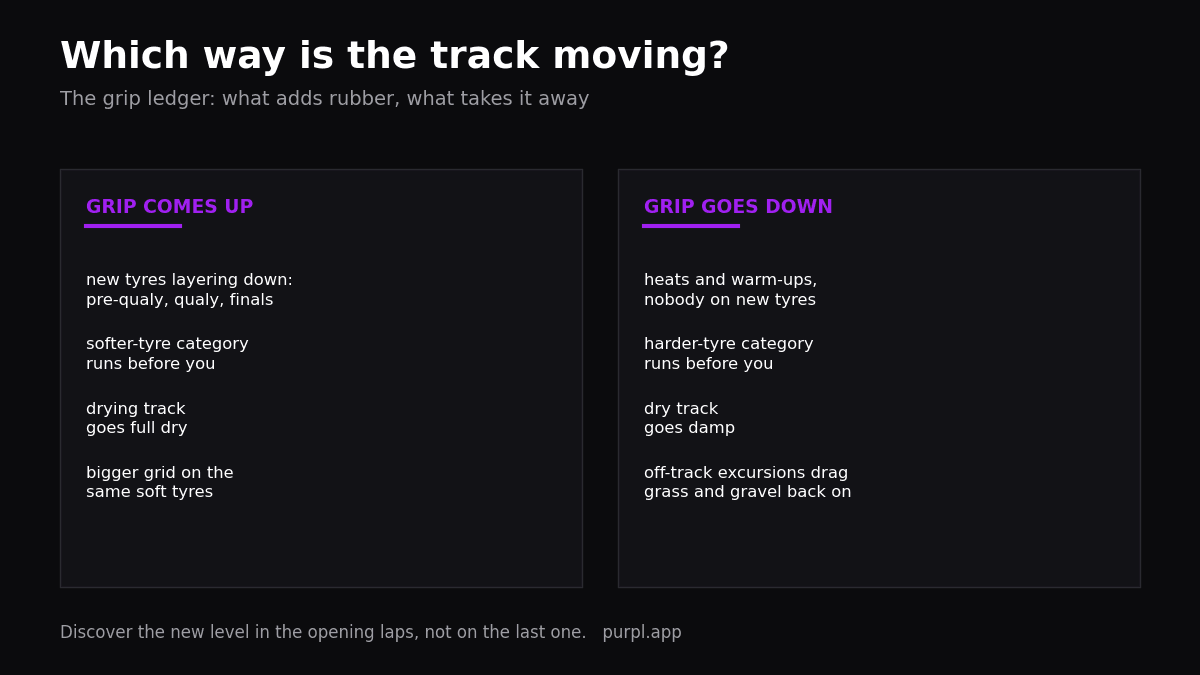
Read those two lists before your next race weekend, then read the timetable. Place your category's sessions against everyone else's, check who's bolting on new tyres, and you'll know before the engine starts which way the surface is probably moving.
Probably. Not certainly. We'll get to that.
Reading track grip evolution in your data
The lists explain why grip levels move. The logger shows how much.
The cleanest gauge in the data is minimum corner speed. With the setup frozen and the driving stable, minimum speeds that creep up session after session are telling you the surface is coming to the whole field at once.
The driver didn't get braver. The track got stickier.
Check the fast corners first. High-load corners respond to fresh rubber sooner than slow hairpins do, and a sector view shows which parts of the lap "switch on" first. That's a job for sector analysis.
Lap-time progression shape is the second read. On a rubbering track the whole session drifts faster: the median lap improves, not just the hero lap. On a dirtying track, one specific corner suddenly starts costing the whole field time, usually right after someone's trip through the gravel drags debris back onto the line.
Then comes the question that separates honest drivers from happy ones. Am I improving, or is the track?
Compare your gain against the session's pace evolution. If the field found three tenths and you found three tenths, you found nothing. If the field found three and you found six, the extra three are yours.
It's the same logic that runs through delta time work and the wider data analysis routine. Always ask what the baseline did. Every time.
And here's the trap. Grip evolution mimics setup problems almost perfectly.
A kart that slides in the afternoon on its morning settings looks exactly like a kart with wrong pressures or a broken balance. Before touching anything, ask what the track did between the two runs.
Track first. Kart second.
The pressure side of that confusion is mapped in kart tire pressure, the balance side in understeer and oversteer. Consistency data helps you split them: grip moves between sessions, while a setup problem follows the kart into every session it runs, no matter what the surface is doing. That distinction lives in lap consistency.
Grip discovery, the skill side
Data tells you what the track did. In the race, you have to sense what it's doing right now.
The driver's job is to discover the new grip level quickly and adapt, because whoever spots the change earliest and adapts quickest is fastest in the opening laps. It's too late to figure it out on the last lap. The race is over.
That takes a cocktail of skills. You need real driving sensibility to "feel" the grip, fast reactions to countersteer when you cross the limit, and eagle eyes to spot dirt before it costs you.
So many times it happened to me to spot some dirt on the track and brake one or two metres earlier. That kept me on the optimal line, and I gained positions on drivers who didn't see it and ran wide.
Cheap positions? Completely. But only if your eyes are doing their job at racing speed.
And don't expect this skill overnight. It took Max Verstappen years of karting practice to master grip discovery, and the same will be true for you, me and everyone else. No shortcuts.
KartClass's guide to finding grip on the kart track is a decent primer; the rest is seat time.
The skill transfers, too. Walking into a circuit you've never driven is grip discovery stretched over a whole day, the exact situation covered in learning a new track.
Why you can't out-plan the track
Here's the uncomfortable part. Knowing all the factors doesn't mean you can forecast them.
Conditions don't change so predictably that you can anticipate exactly what to change on the kart. Nobody can predict it to perfection. Not even F1 teams with hundreds of millions in budget.
And even on the rare day when you do read the grip development right, the clock has a habit of beating you anyway. You realise 20 minutes before qualifying that the track has picked up grip, and the window for real setup changes is already gone.
So the play is not forecasting. The play is reading and reacting faster than the people around you.
Give me a driver who reads grip changes over a driver who memorises setup sheets, and I'll take that trade every single weekend. That's the edge.
Setup still matters, obviously. When the surface is heavily rubbered the kart usually wants freeing up, and TKART's walkthrough of kart setup on rubberised tracks covers those moves well. The fundamentals live in kart setup basics.
But the order matters more than the menu. Read first. React in your driving immediately, and change the kart only when the data says the gap survives the grip story.
FAQ
Why is the track faster in the afternoon?
Usually because morning sessions laid rubber into the racing line and the surface temperature climbed toward the tyres' working range. More rubber plus warmer asphalt means higher grip levels, so the same driving produces a better lap.
It's not guaranteed, though. If the afternoon runs harder-compound categories, or wind drags dust across the circuit, grip can fall while the clock says it should rise. Read the sessions, not the time of day.
What is track "rubbering in"?
Rubbering in is the build-up of tyre rubber on the racing line as karts circulate. Loaded tyres leave a film of rubber in the corners, the line darkens, and grip climbs, which is why finals day rarely feels anything like Friday practice.
The effect is strongest when many drivers run new, soft tyres. It partially resets overnight, with rain, or when dust and dirt cover the line again.
How do I know if it's the track or me?
Benchmark against the field. Take your lap-time gain across two sessions and compare it with the pace gain of the whole category, or at least of two or three reference drivers. Matching the field's improvement means the track moved; beating it means you did.
Minimum corner speeds at a frozen setup tell the same story with more precision. If everyone's minimums rose together, that's track grip evolution doing the work.
Does rain reset track grip?
Mostly, yes. Water lifts dust and oils to the surface, and the rubbered line loses its advantage. In the wet the racing line can even become the slippery part of the track.
Once it dries, the build-up starts again from a greener baseline. Wet sessions have their own data logic, covered in wet weather karting data.
Alessio Lorandi started karting at six and won the 2013 CIK-FIA Karting World Championship. He raced through Formula 3, GP3 and Formula 2 before founding Purpl, an AI data coach for karting drivers.