Kart Slip Angle: What It Is and Where It Shows in Your Data
Slip angle is the gap between where a tyre points and where it goes. At 15 m the geometry asks for 4 degrees of steering, and the gap to it shows in your traces.

What is slip angle in a kart?
Slip angle is the angle between where a tyre points and where it is really going. A tyre only pushes the kart sideways when those two differ, so every corner you take has slip angle in it, even the clean ones. It is not a spin or a slide.
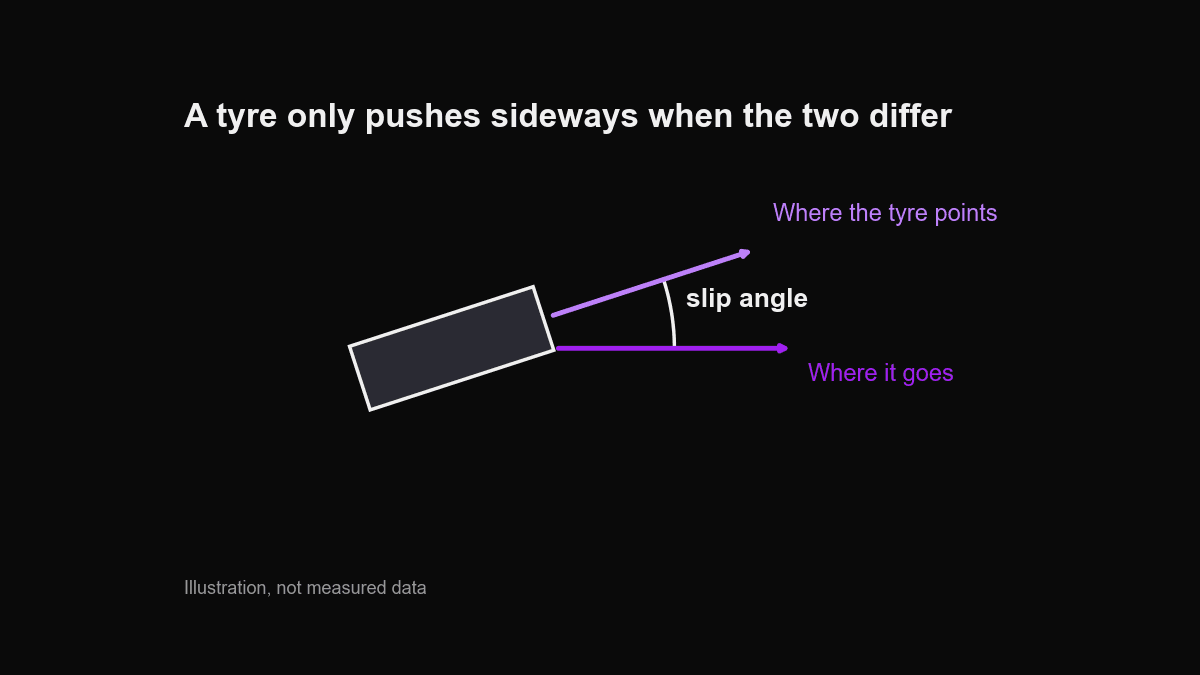
That is the whole definition. I will not say it again, and I will not give you a number for it, for a reason I come back to at the end. What you can do is read where it shows in your data, and that is most of this page.
Why does a kart need slip angle to corner at all?
Because rubber has to be dragged a little sideways to make sideways force. Ask for more lateral g and the tyre needs more slip angle to give it. That goes up to a peak. After the peak, more angle gives you no more force, it just costs you speed.
In the model of a KZ shifter on an OTK chassis, I held a 15 m corner and went from 1.0 g to 1.5 g. The speed goes from 43.7 to 53.5 km/h (calculated). The outside front tyre goes from about 43 kg to about 53 kg (estimated), and the inside front falls from about 25 kg to about 15 kg. The model's front and rear slip angles both rise with it, which is the direction you expect, because the loaded outside tyres need more angle for the force they carry. I am only quoting the direction. The size of the slip angles in the model is indicative only.
One more direction from the model. Keep 1.5 g and change the radius from 8 m to 30 m, and the rear slip angle moves far less than the steering the geometry asks for. Slip angle follows how hard you corner much more than how tight the corner is. Same warning: indicative only.
If you have read the inside rear wheel post, the percentage of rear tyre slip in there is a different thing. That one is the tyre surface speed against the ground, from the solid axle. Slip angle is sideways. Both exist at the same time. Why the inside rear lifts has the first one.
How much steering does the corner ask for before any slip?
This one you can calculate, and it is the useful one. If the tyres had zero slip angle the kart would follow the geometry, and the front wheels would need an angle of about the wheelbase divided by the radius. With a 1045 mm wheelbase and a 15 m corner that is 1.045 / 15 = 0.070 radians, 4.0 degrees. The model's two front wheels bracket it: 4.1 degrees inside, 3.9 outside (calculated).
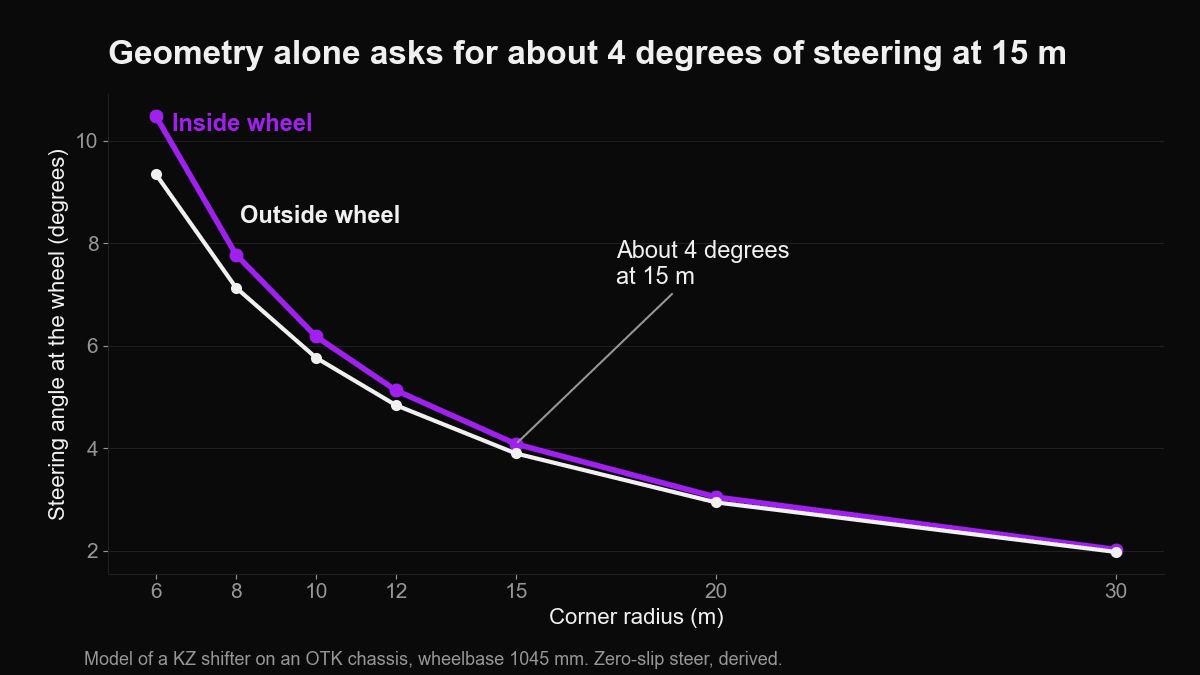
It does not depend on speed or on g. It is only the radius. At 8 m it is 7.8 degrees on the inside wheel and 7.1 on the outside, and at 30 m about 2.0 on both. And you can get the radius out of your own data: speed in metres per second, squared, divided by lateral g times 9.81. That is the same arithmetic as in kart corner speed.
Now the part that connects to the tyres. The steering you really need is the geometry plus the front slip angle minus the rear slip angle. So the difference between the steering you used and the steering the geometry asked for is front slip minus rear slip. The model calls it the understeer angle, steer needed minus zero-slip steer. More steering than the geometry asks for means the front is working harder than the rear. Less means the rear is.
Where does slip angle show in your data?
Slip angle is not a channel. The MyChron 6 guide lists speed, position, linear and lateral acceleration for its GPS, and slip angle is not on that list. You read it from three traces together.
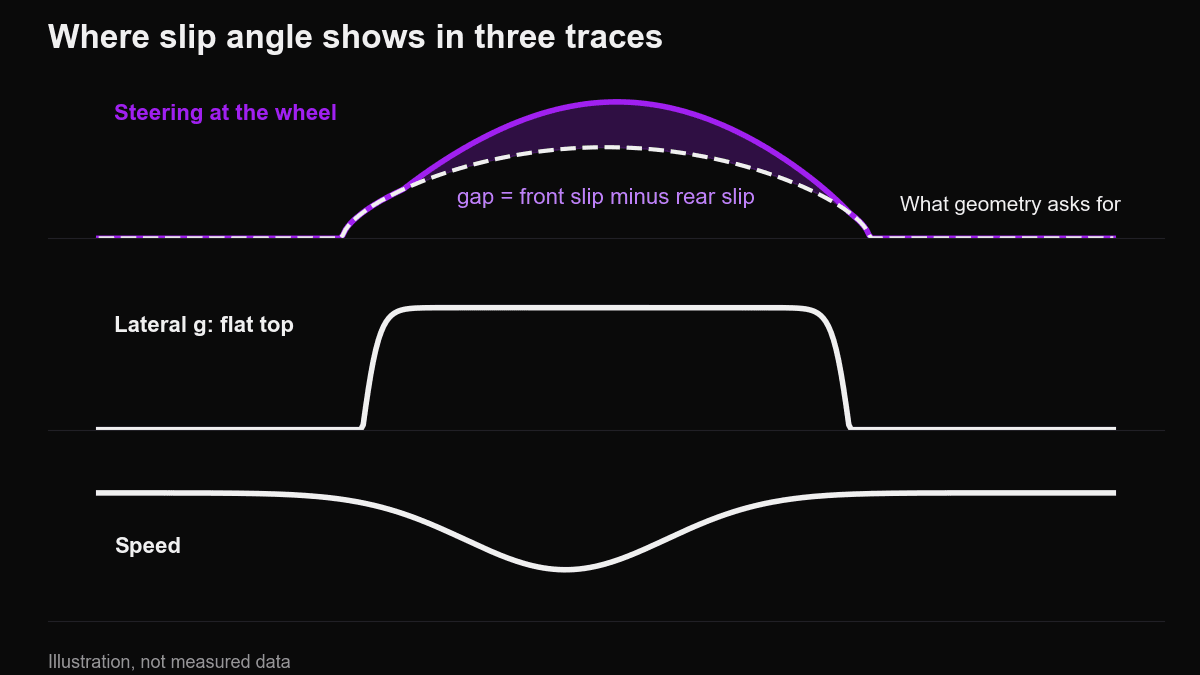
- Steering. This needs a steering angle channel at the front wheels, so check that your kart and your logger have one before you count on it. If you do, compare it with wheelbase over radius through the middle of the corner. The gap is front slip minus rear slip. A gap that grows while lateral g stays flat is the front asking for angle and getting nothing back.
- Lateral g. The flat top in the middle of a corner is the tyres on or near their peak. Asking for more steering up there does not lift the line. As I put it in one recording: "when you have too much steering angle it essentially becomes drag". You see it in the data as the same g, more steering and less speed. If you want the g-g picture of this, the friction circle is the page.
- Speed. A kart that needs more angle than it can use does not pick up speed on the exit. I said it about my own racing with a shifter: "I could see that the speed was picking up less in the exit of the corners". Look at speed 50 m after the corner, not only at the minimum.
A rear that needs more slip angle than it has shows in the other way. The steering has to unwind and come back to catch it. In the steering-inputs episode I called that a vicious cycle of corrections. On the trace it is a steering line that wiggles on a g that is already flat.
For your own lap, open the sample session and read one corner this way: radius from speed and lateral g, geometry from the radius, then see what the steering and the exit speed say. Kart understeer or oversteer goes through the balance diagnosis with a decision tree.
What can the model not tell you about slip angle?
Two things. The first is the size of the slip angles. In the model the tyre grip, slip and relaxation numbers are placeholders until they are calibrated on real telemetry, so the slip angles it prints are indicative only and I did not quote any. The second is front against rear. The model uses one tyre curve for all four tyres, so a real kart with different front and rear tyres will differ.
What you can trust is the geometry, the loads as an estimate, and the direction of everything above. Use the numbers to know where to look in the trace, not as a target to match.
Once you know what the trace says, what to do with your hands and your braking to cure it is the in-seat side, and I wrote that on Senndit: understeer vs oversteer, what they are and what is better.