Category: Uncategorized

  • Karting Telemetry Glossary: 75 Data Terms Every Driver Should Know

    Karting Telemetry Glossary: 75 Data Terms Every Driver Should Know

    Every paddock speaks two languages. There’s the one drivers use over a chassis, and the one the data screen speaks back.

    This karting glossary covers the second one. 75 terms, grouped by topic, each defined in plain words so a driver, a parent or a mechanic reads the same meaning.

    I started karting at six, and the jargon arrived faster than the lap times did. The vocabulary kept growing through the 2013 world championship and all the way into F3, GP3 and F2. But almost every word in those briefings was already alive in karting.

    Use the page two ways. Skim the section you’re working in, or ctrl+F straight to the term that confused you.

    Karting telemetry glossary cover with purple data trace and term icons on black

    Core channels

    A channel is the atom of telemetry. Everything else on this page is built from these.

    Telemetry. The recording of what the kart and driver did on track, sampled many times per second and downloaded for review. The wider engineering sense covers any measurement taken at a distance.

    Data logger. The onboard unit that records every channel during a session and then hands the laps to your analysis software; the hardware options are compared in kart data loggers explained.

    Channel. One stream of recorded data, such as speed or RPM. Each sensor feeds at least one channel.

    Sampling rate. How many readings a channel records per second, measured in hertz, so a 10 Hz channel writes ten values into its file every single second.

    GPS speed. Kart speed calculated from satellite positioning instead of a wheel sensor. The standard speed source on modern karting loggers.

    RPM. Engine revolutions per minute, usually read from the spark plug lead. The oldest karting channel and still one of the most useful, as the kart RPM data guide shows.

    Water temperature. Coolant temperature in a liquid-cooled engine, the channel that tells you whether the engine sits in its working range or is quietly being cooked.

    EGT. Exhaust gas temperature, taken by a probe in the exhaust header and used by drivers and mechanics to judge carburation, the craft covered in the kart EGT guide.

    CHT. Cylinder head temperature. The air-cooled engine’s stand-in for water temperature.

    Lambda. The air-fuel ratio measured by an oxygen sensor in the exhaust. A direct read on rich or lean running, explained in the lambda sensor guide.

    Throttle position. How far the throttle is open, expressed as a percentage. It needs its own sensor on the pedal or carburettor.

    Brake pressure. Hydraulic pressure in the brake line. It shows how hard you brake and how you release, not just where you started.

    Steering angle. Rotation of the steering wheel, logged by a dedicated sensor, and the channel that reveals the small corrections you never felt yourself make.

    Traces, graphs and math channels

    Speed trace. The graph of speed against distance for a single lap, the first chart every data session opens with and the backbone of every comparison that follows.

    Delta time. The running time gap between two laps at every point on the track, the one line that shows where time is won and lost, unpacked in delta time explained.

    Overlay. Two or more laps drawn on the same chart for direct comparison. The working method lives in the overlay analysis guide.

    Reference lap. The lap everything else gets compared against. Usually your best, sometimes a teammate’s.

    Ghost lap. A reference lap replayed alongside your own driving, like the ghost car in a racing game.

    Track map. The plotted shape of the circuit, built from GPS or from speed and lateral G, which ties every data point to a physical place on track.

    Math channel. A new channel calculated from existing ones rather than measured directly. The recipes are in math channels for karting.

    Smoothing. A filter that averages out jitter in a channel so the underlying shape is readable. Too much of it hides real detail.

    Sampling noise. Random wobble in a channel caused by the sensor or electrical interference. The kart didn’t do it; the electronics did.

    GPS drift. Position error that creeps into satellite data and bends the track map or the speed trace.

    Video sync. Lining up onboard video with the logged data so every frame matches its exact point in the traces and your eyes can confirm what the numbers claim.

    Lap and time analysis

    Theoretical best. Your fastest sectors from one session stitched together into a single imaginary lap, which makes it the lap you have already proved possible, just in pieces.

    Sector. A timed segment of the lap, usually three or four per circuit. Working sector by sector is its own discipline, covered in sector analysis for karting.

    Microsector. A much smaller timed segment, often a single corner or less, giving finer resolution for finding exactly where the time hides.

    Split time. The elapsed time at a fixed point on the lap, shown the moment you cross it.

    Lap consistency. How tightly your lap times group across a run; why that beats one hero lap is the argument of the lap consistency article.

    Consistency spread. The gap between your best and worst representative laps in a stint. Smaller is better.

    Purple lap, purple sector. The fastest lap or sector of the entire session, coloured purple on most timing screens. Yes, that’s where the name Purpl comes from.

    In-lap. The lap that ends in the pits. Usually slow, and excluded from analysis.

    Out-lap. The lap that starts from the pits, spent bringing tyres and engine up to temperature.

    Flying lap. A complete lap started at full speed. The only kind worth comparing.

    Driving metrics

    These are the numbers that describe the driver rather than the kart. They sting more, and they teach more.

    Lateral G. Sideways acceleration in cornering, expressed in multiples of gravity, and the measure of how hard the tyres are working across the kart.

    Longitudinal G. Acceleration and braking force along the kart’s direction of travel.

    Combined G. Lateral and longitudinal G combined into one total grip demand.

    Friction circle. The plot of lateral against longitudinal G, showing how much of the tyre’s total grip you actually use; read it properly with the friction circle guide.

    Minimum speed. The slowest point of a corner. One of the most telling numbers in kart data.

    Apex speed. Speed at the apex of the corner. Often the same as minimum speed, but not always.

    Corner exit speed. Speed at the point where the kart runs straight again, where small gains compound all the way down the following straight.

    Braking point. Where braking begins, read from brake pressure or the speed trace.

    Brake release. The way brake pressure comes off as the corner arrives. Its shape separates smooth entries from snappy ones.

    Trail braking. Carrying reducing brake pressure past turn-in instead of finishing all braking in a straight line.

    Coasting. Time spent on neither throttle nor brake. A little is deliberate; most of it is wasted lap time.

    U-shape vs V-shape corner. Two ways through the same corner: a wide arc that protects rolling speed, or a deep brake, sharp rotation and early throttle. The traces show which one a corner rewards.

    Racing line. The path through a corner that produces the best lap time. Not always the geometric ideal.

    Engine and gearing

    Limiter. The maximum RPM the ignition allows the engine to reach; hitting it long before the braking point means the gearing is too short.

    Limiter metres. The distance travelled sitting on the limiter before braking. A gearing diagnostic you read straight off the RPM trace.

    Gear ratio. The relationship between engine speed and axle speed, set by the two sprockets. How to choose it is the subject of the kart gear ratio guide.

    Sprocket. The toothed wheel the chain runs on. Swapping rear sprocket teeth is karting’s main gearing change.

    Minimum RPM floor. The lowest RPM the engine falls to in the slowest corner, watched because dropping below the engine’s happy range kills the drive away from it.

    Short shift. In gearbox classes, changing up before peak RPM to settle the kart or protect the engine.

    Tyres and track condition

    Cold pressure. Tyre pressure set before the run with the tyre at ambient temperature, the starting point of the whole method in the kart tire pressure guide.

    Hot pressure. Pressure measured the moment you come in, while the heat is still in the tyre.

    Pressure delta. The difference between hot and cold pressure. A direct read on how much heat the tyre built during the run.

    Tyre temperature. Surface or carcass temperature of the tyre, measured by probe or infrared sensor.

    Temperature window. The range in which a tyre grips best. Below it the tyre slides; above it the tyre overheats and fades.

    Heat cycle. One full warm-up and cool-down of a tyre. Every cycle changes the compound a little.

    Grip evolution. The change in track grip across a day as rubber, temperature and traffic shift, rewriting your numbers from one session to the next.

    Rubbering in. The laying down of tyre rubber on the racing line, raising grip lap after lap.

    Green track. A surface with little rubber on it: after rain, overnight, or at a freshly cleaned circuit. Low grip, for now.

    Timing hardware and session terms

    This is the language of timing screens and debrief rooms, from club practice to FIA Karting world championship rounds run under the international federation.

    Magnetic strip. A strip buried in the track surface that older lap timers detect to mark the start of each lap.

    Transponder. The small onboard unit that official timing uses to identify each kart as it crosses the loop; systems from suppliers such as MYLAPS run most race timing worldwide.

    Beacon. A trackside transmitter, or a GPS-defined line, that tells your own logger where the lap starts and ends.

    Stint. One continuous run on track, from rolling out to coming back in.

    Stint shape. The pattern of lap times across a stint: where they peak, where they fade. A tyre and pressure story told in lap times.

    Session sheet. The one-page record of a session: setup, conditions, pressures, lap times, notes. Cheap to keep, expensive to skip.

    Debrief. The structured review after a session, with data and video open, done before memory rewrites the run.

    Baseline. The known setup and lap time every change gets measured against.

    Back-to-back test. Two runs separated by exactly one change, compared directly.

    One-variable rule. Change one thing at a time. Change two and the data can’t tell you which one worked.

    CSV export. Your data saved as plain comma-separated text that any software can open. What to do with it fills the telemetry CSV export guide.

    Anonymized data. Telemetry stripped of identifying details so laps can be pooled and compared across many drivers without naming anyone.

    AI coaching. Software that reads your data and turns it into plain-language feedback, the job a salaried data engineer does for professional teams, made available to a club driver.

    Using this karting glossary

    A glossary tells you what the words mean. It can’t tell you which ones matter on a Tuesday test day.

    So here’s my order, for what it’s worth. Speed trace, minimum speed, delta time. Those three answer most of the questions a karting weekend asks.

    To watch all of this vocabulary working together on real laps, read the karting telemetry guide next. And when a word on a timing screen or a forum makes no sense, come back. That’s what this page is for.


    Alessio Lorandi started karting at six and won the 2013 CIK-FIA Karting World Championship. He raced through Formula 3, GP3 and Formula 2 before founding Purpl, an AI data coach for karting drivers.

  • How to Get Into Kart Racing: The Complete Starter Guide

    How to Get Into Kart Racing: The Complete Starter Guide

    Everyone in motorsport started somewhere. And almost everyone started here.

    Karting is where you learn the fundamentals that never leave you. Braking, racecraft, the first crashes, the first wins.

    I started at six years old. And the sport carried me to a world championship and into Formula 2. But the entry door I walked through is the same one available to you or your kid this weekend.

    And it costs about as much as a cinema ticket.

    This is the realistic map: the ladder, the money, the mistakes to skip. And the honest odds nobody puts in the brochure.

    How to get into kart racing complete starter guide cover graphic

    Step one: rental karts, and take them seriously

    Your first sessions should be rental karts. And not just because they’re cheap.

    I’ll admit something. If someone had told me in my racing years that rental karting could make you a better driver, I would have laughed.

    I went rental karting on holidays, in Sardinia, once in Ibiza with my karting teammates and Mick Schumacher who raced against us back then. Later in the Netherlands with my F3 teammates Arjun Maini and Charles Leclerc, beating each other up for fun. Great memories, zero training intent.

    I’ve changed my mind since. Specifically about indoor rental tracks. They’re unforgiving in a way that builds precision.

    Walls instead of run-off, narrow lanes, tight corners. Miss your line by half a metre indoors and you feel it immediately, where an outdoor circuit would forgive you.

    For a beginner, that feedback loop is gold. Drive rentals until you’re consistently at the front of public sessions. Racing strangers teaches you more racecraft than lapping alone ever will.

    Step two: understand the ladder before you climb it

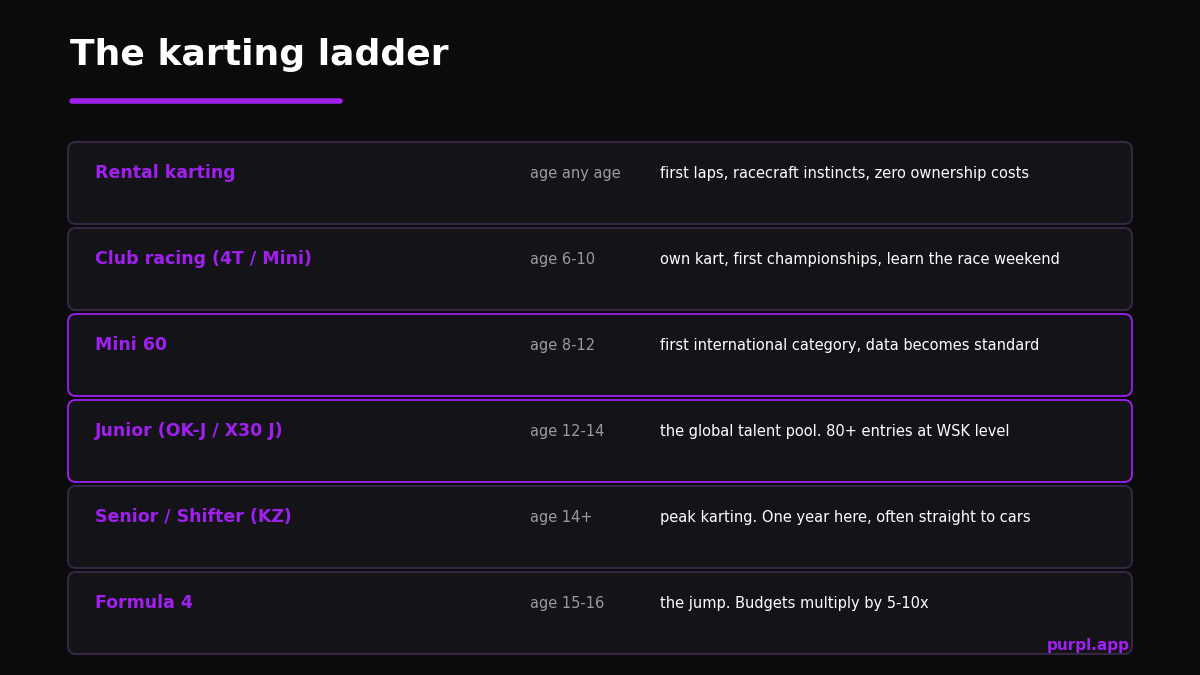
    The karting ladder from rental karts through Mini 60, Junior and Senior categories to Formula 4

    Competitive karting is organised by age and engine. Kids typically enter around 6-10 in club categories, move to Mini 60 between 8 and 12, Juniors from 12 to 14, then Seniors or Shifters.

    The traditional path put a year in Seniors and a year in shifter karts before car racing at 16. These days many jump to Formula 4 at 15-16 directly, skipping that last shifter year.

    Each step up costs meaningfully more. So the honest rule of the ladder is: results justify steps. Wins at one level are the argument for funding the next, unless your resources are unlimited, and for most families they are very much not.

    The full category system is mapped in karting classes explained. That includes the 2-stroke vs 4-stroke split and what each class costs to run.

    Adults: the ladder isn’t only for kids. Club racing in 4-stroke classes and masters categories is thriving, cheaper than junior international karting by an order of magnitude. And the racing is genuinely hard.

    Step three: the money conversation

    Have it early. With real numbers. Rental sessions run €20-40.

    A season of club racing with a used kart might be a few thousand euros. A serious national season runs into five figures, and the international scene, WSK, Euro Series, world championship, costs more per year than most families spend on a house deposit.

    The complete breakdown with line items is in how much kart racing really costs. Read it before buying anything.

    Two rules save beginners the most money. Buy used equipment. Karts hold value badly.

    And beginners can’t use the difference between a new chassis and a two-year-old one. So spend the savings on track time. Because seat time is the only purchase that always works.

    Your first owned kart

    When the rental phase ends, resist the showroom. A two-year-old chassis from a respected brand, bought from a club racer who’s upgrading, is the correct first kart. And the difference between it and a new one is invisible to a beginner in every way except the invoice.

    Budget for the unglamorous list too: trolley, basic tools, spare sprockets and chains, wet tyres on spare rims, and a used data logger. It costs less than one set of new tyres and pays back forever.

    Engine choice is really class choice, decided by what actually races at your local club. Go watch a club race before buying anything and count entries per class.

    The best class for a beginner is the one with the biggest grid at your home track. Full stop. Twenty mediocre rivals teach you more than three fast ones, and resale is easier in a popular class too.

    Safety gear: a kart-homologated helmet, an abrasion-rated suit, gloves, and proper boots are non-negotiable. And a rib protector is the item beginners skip and regret first. Because karts don’t have seat belts and ribs meet seat edges hard.

    Buy the helmet new, always; everything else can be sensibly used.

    A realistic first season

    Here’s a first-season plan that builds drivers instead of disappointments. Months one and two: practice days only, every second weekend if budget allows, each one with a goal, this is where the one-question habit from the data analysis method starts.

    Months three to six: enter club races with zero result expectations; the goal is finishing races, learning procedures, starts, and traffic.

    Second half of the season: pick one modest, measurable target, top ten in class, or qualifying within a defined gap of the front. And let the data measure progress toward it rather than the championship table, which mostly measures budget and experience at this stage.

    What ruins first seasons, in order of frequency? Equipment-blaming (the data usually disagrees), parents who turn race day into exam day. Then skipping practice to spend the budget on more race entries.

    And chasing setup changes before the driver is consistent enough to feel them, the trap explained in kart setup basics.

    Step four: know the odds, then beat them

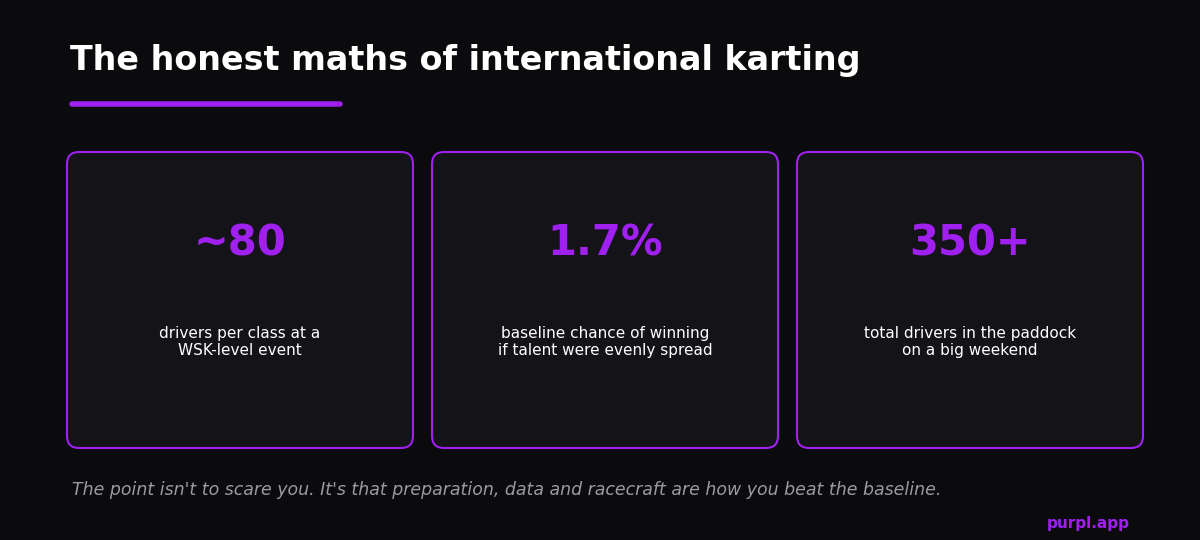
    International karting statistics: around 80 drivers per class means a 1.7 percent baseline chance of winning

    Here’s the maths nobody hands out with the entry form. A club race might have 20-30 karts in your class. An international event is another planet.

    WSK weekends start on Wednesday, you park ten minutes’ walk from a paddock holding 350-plus drivers, and your class alone can field 80, at the peak years over a hundred. Eighty drivers means a baseline 1.7% chance of winning if ability were spread evenly.

    The point of that number isn’t discouragement, it’s direction. Talent is real. But it’s not the variable you control on a Tuesday.

    Preparation is. Arriving with the track learned, the kart in the window, and your own data telling you where the next tenth is.

    That’s how the baseline gets beaten. And it’s the entire reason this blog and Purpl exist.

    What a race day actually looks like

    Demystifying the first race removes half its stress. So here’s the standard club Sunday. Arrive early, sign on, scrutineering checks your kart and gear.

    A drivers’ briefing covers flags and local rules, listen properly, the questions asked at briefings are answered in penalties later. Then the rhythm: a short practice or warm-up, qualifying that sets the grid, one or two heats, and a final.

    Between sessions you’ll have under an hour, which is exactly the window the twenty-minute data routine was designed for: download, one corner, one decision, tyres and fuel, breathe.

    Expect three surprises. The pace of the day, club racing runs on a strict clock and being late to the grid is a self-inflicted penalty.

    Standing starts or rolling starts that no practice day prepared you for, ask an experienced racer to talk you through the local procedure before your first one. And the noise of close racing: your first heat will feel chaotic, lap five of your third race it will feel like home.

    Karting paddocks are also, despite the rivalries, absurdly helpful to newcomers who ask politely; the same culture lives online at KartPulse.

    Fitness, age and other honest answers

    Small habits with outsized returns, learned the hard way at international paddocks. Drink water all day, not just when thirsty, because dehydration shows up as slow hands and bad decisions in the afternoon finals long before you feel it.

    Eat light at lunch on race days. And sleep before race weekends like it’s training. Because it is.

    Can you start at 30? Yes, and you’ll have company in masters and club classes; the ladder above is for the junior pathway, not a visa requirement.

    Is karting physical? More than it looks: necks, forearms and core take a beating, ribs especially, and basic conditioning improves both lap time and enjoyment within weeks.

    Do you need a competition license? For organised racing, yes, a short course and a medical through your national federation, and clubs walk beginners through it routinely.

    None of these are real barriers. The only real barrier is starting. That’s what the rental session this week is for.

    The beginner’s shortcut list

    Things I wish every newcomer knew on day one. Join a club and do a license course; in most countries the national federation lists accredited clubs, and internationally the sport runs under FIA Karting.

    Get coaching early, before bad habits calcify; even three sessions change a driver’s trajectory. Start logging data from your first owned kart, a used logger costs little and the habit, explained from zero in the karting telemetry guide, compounds for your entire career.

    Learn the standard mistakes before making them all personally, I’ve catalogued them in beginner karting mistakes.

    And parents of young drivers: your role is the most misunderstood job in the paddock. So read the parent’s guide to junior karting before your first race weekend, not after it goes wrong.

    For the practical questions that fill a first season, what to pack, how a race day runs, when to practice, the race weekend checklist covers the logistics.

    One more honest answer while we’re here. How long until you’re competitive? With regular seat time and the data habit, expect to be racing mid-pack at club level within a season, and genuinely fighting at the front in your second.

    Anyone promising faster is selling something.

    Is it worth it?

    I’m biased, and the answer is yes. Not because of Formula 1. Statistically that door opens for almost nobody, and you should hear that early too.

    It’s worth it because karting compresses lessons most people wait decades for. How to lose on Sunday and analyse it on Monday, how to perform when nervous. How to take responsibility for your own mistakes (your data makes them hard to outsource), how to work inside a small team.

    Drivers who climb to cars carry those lessons up, the path described in from karting to cars.

    The ones who stay in karting keep one of the best-kept secrets in sport: the racing at club level is better than almost anything you can buy for the money.

    Start with a rental session this week. Everything else in this guide is optional until then.


    Alessio Lorandi started karting at six and won the 2013 CIK-FIA Karting World Championship. He raced through Formula 3, GP3 and Formula 2 before founding Purpl, an AI data coach for karting drivers.
  • Track Grip Evolution: Reading Changing Conditions Through Your Data

    Track Grip Evolution: Reading Changing Conditions Through Your Data

    The track is not a constant. Same kart, same driver, same setup, different hour: different lap time.

    Most drivers treat grip as background. It’s just “how the track is today”. The fast ones treat track grip evolution as a proper channel, something to read and react to all weekend long, the same way they read speed or RPM.

    That’s the whole argument of this article. The rest is how.

    Track grip evolution guide: reading changing kart track conditions through telemetry data

    What actually changes in the surface

    Three forces move grip on a kart track: rubber, temperature and dirt.

    Rubber first. Every hot tyre that loads up in a corner leaves a thin film of rubber on the asphalt, and lap after lap the racing line darkens and gets stickier.

    Look at where a track turns black. The corners, far more than the straights, because rubber transfers where the tyre is loaded hardest.

    Temperature works on top of that layer. A cold surface struggles to switch tyres on, and a baking afternoon surface can push them past their window. The asphalt itself matters too; TKART has a good technical piece on asphalt and its grip characteristics.

    And dirt is the eraser. Dust, sand, grass and gravel sit on top of the rubber and cut grip wherever they land. One corner can be enough.

    None of this is exotic physics. But the mix shifts by the hour, which is why the same corner can want two different braking points before and after lunch. Grip in karting moves by whole tenths between a morning run and an afternoon run as rubber goes down.

    Track conditions in karting simply move faster than most drivers give them credit for.

    What sends grip up, and what sends it down

    Grip conditions always change from session to session, even if only slightly. There are many factors involved, and I won’t claim to know all of them. But here are the big ones.

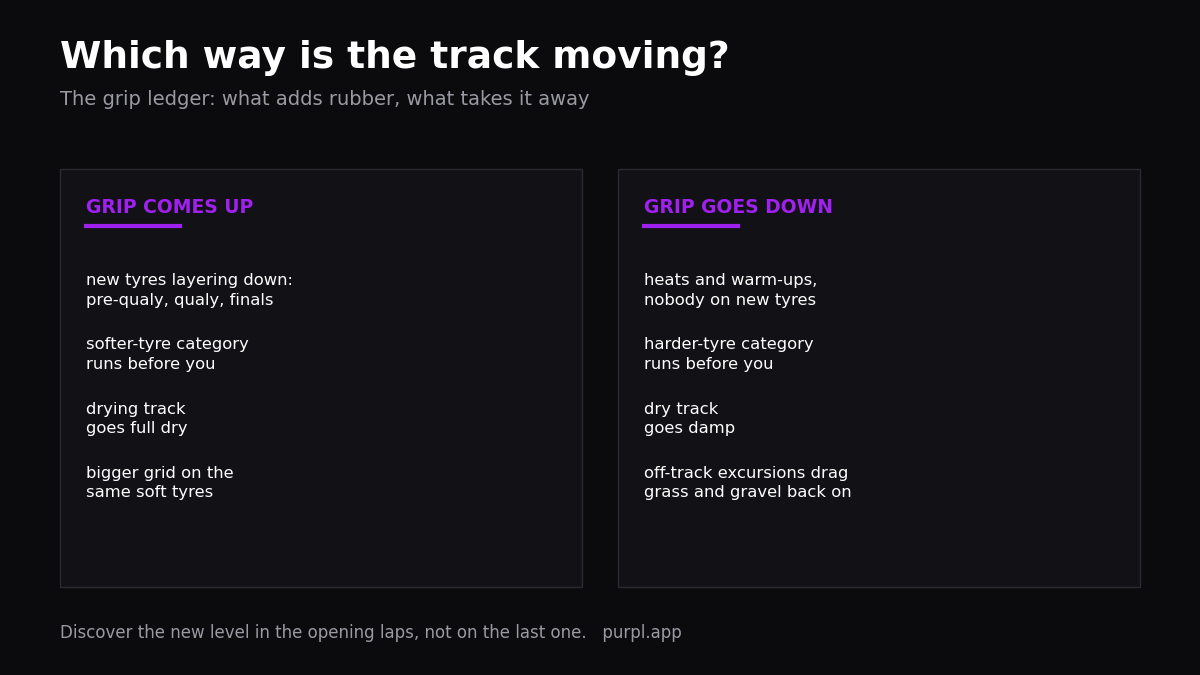
    Track grip increases when:

    • Lots of drivers are layering down new tyres. Pre-qualifying, qualifying and finals are the classic moments.
    • You run after a category on softer tyres than yours.
    • The track goes from drying to fully dry.
    • The driver count rises on the same soft tyres. Going from 20 karts to 36 means more rubber laid down, and more rubber means more grip.

    Track grip decreases when:

    • Drivers stop mounting new tyres. Heats, warm-ups and pre-finals usually run on used sets.
    • You run after a category on harder tyres than yours.
    • A dry track goes damp.
    • The driver count drops, say from 36 back to 20.
    • Drivers go off and drag grass, gravel, mud or tyre pickup back onto the line.
    • Rarely, karts losing water, fuel or oil make the surface weirdly unpredictable.
    Track conditions karting grip up grip down factors card: new tyres, compounds, weather, dirt

    Read those two lists before your next race weekend, then read the timetable. Place your category’s sessions against everyone else’s, check who’s bolting on new tyres, and you’ll know before the engine starts which way the surface is probably moving.

    Probably. Not certainly. We’ll get to that.

    Reading track grip evolution in your data

    The lists explain why grip levels move. The logger shows how much.

    The cleanest gauge in the data is minimum corner speed. With the setup frozen and the driving stable, minimum speeds that creep up session after session are telling you the surface is coming to the whole field at once.

    The driver didn’t get braver. The track got stickier.

    Check the fast corners first. High-load corners respond to fresh rubber sooner than slow hairpins do, and a sector view shows which parts of the lap “switch on” first. That’s a job for sector analysis.

    Lap-time progression shape is the second read. On a rubbering track the whole session drifts faster: the median lap improves, not just the hero lap. On a dirtying track, one specific corner suddenly starts costing the whole field time, usually right after someone’s trip through the gravel drags debris back onto the line.

    Then comes the question that separates honest drivers from happy ones. Am I improving, or is the track?

    Compare your gain against the session’s pace evolution. If the field found three tenths and you found three tenths, you found nothing. If the field found three and you found six, the extra three are yours.

    It’s the same logic that runs through delta time work and the wider data analysis routine. Always ask what the baseline did. Every time.

    And here’s the trap. Grip evolution mimics setup problems almost perfectly.

    A kart that slides in the afternoon on its morning settings looks exactly like a kart with wrong pressures or a broken balance. Before touching anything, ask what the track did between the two runs.

    Track first. Kart second.

    The pressure side of that confusion is mapped in kart tire pressure, the balance side in understeer and oversteer. Consistency data helps you split them: grip moves between sessions, while a setup problem follows the kart into every session it runs, no matter what the surface is doing. That distinction lives in lap consistency.

    Grip discovery, the skill side

    Data tells you what the track did. In the race, you have to sense what it’s doing right now.

    The driver’s job is to discover the new grip level quickly and adapt, because whoever spots the change earliest and adapts quickest is fastest in the opening laps. It’s too late to figure it out on the last lap. The race is over.

    That takes a cocktail of skills. You need real driving sensibility to “feel” the grip, fast reactions to countersteer when you cross the limit, and eagle eyes to spot dirt before it costs you.

    So many times it happened to me to spot some dirt on the track and brake one or two metres earlier. That kept me on the optimal line, and I gained positions on drivers who didn’t see it and ran wide.

    Cheap positions? Completely. But only if your eyes are doing their job at racing speed.

    And don’t expect this skill overnight. It took Max Verstappen years of karting practice to master grip discovery, and the same will be true for you, me and everyone else. No shortcuts.

    KartClass’s guide to finding grip on the kart track is a decent primer; the rest is seat time.

    The skill transfers, too. Walking into a circuit you’ve never driven is grip discovery stretched over a whole day, the exact situation covered in learning a new track.

    Why you can’t out-plan the track

    Here’s the uncomfortable part. Knowing all the factors doesn’t mean you can forecast them.

    Conditions don’t change so predictably that you can anticipate exactly what to change on the kart. Nobody can predict it to perfection. Not even F1 teams with hundreds of millions in budget.

    And even on the rare day when you do read the grip development right, the clock has a habit of beating you anyway. You realise 20 minutes before qualifying that the track has picked up grip, and the window for real setup changes is already gone.

    So the play is not forecasting. The play is reading and reacting faster than the people around you.

    Give me a driver who reads grip changes over a driver who memorises setup sheets, and I’ll take that trade every single weekend. That’s the edge.

    Setup still matters, obviously. When the surface is heavily rubbered the kart usually wants freeing up, and TKART’s walkthrough of kart setup on rubberised tracks covers those moves well. The fundamentals live in kart setup basics.

    But the order matters more than the menu. Read first. React in your driving immediately, and change the kart only when the data says the gap survives the grip story.

    FAQ

    Why is the track faster in the afternoon?

    Usually because morning sessions laid rubber into the racing line and the surface temperature climbed toward the tyres’ working range. More rubber plus warmer asphalt means higher grip levels, so the same driving produces a better lap.

    It’s not guaranteed, though. If the afternoon runs harder-compound categories, or wind drags dust across the circuit, grip can fall while the clock says it should rise. Read the sessions, not the time of day.

    What is track “rubbering in”?

    Rubbering in is the build-up of tyre rubber on the racing line as karts circulate. Loaded tyres leave a film of rubber in the corners, the line darkens, and grip climbs, which is why finals day rarely feels anything like Friday practice.

    The effect is strongest when many drivers run new, soft tyres. It partially resets overnight, with rain, or when dust and dirt cover the line again.

    How do I know if it’s the track or me?

    Benchmark against the field. Take your lap-time gain across two sessions and compare it with the pace gain of the whole category, or at least of two or three reference drivers. Matching the field’s improvement means the track moved; beating it means you did.

    Minimum corner speeds at a frozen setup tell the same story with more precision. If everyone’s minimums rose together, that’s track grip evolution doing the work.

    Does rain reset track grip?

    Mostly, yes. Water lifts dust and oils to the surface, and the rubbered line loses its advantage. In the wet the racing line can even become the slippery part of the track.

    Once it dries, the build-up starts again from a greener baseline. Wet sessions have their own data logic, covered in wet weather karting data.


    Alessio Lorandi started karting at six and won the 2013 CIK-FIA Karting World Championship. He raced through Formula 3, GP3 and Formula 2 before founding Purpl, an AI data coach for karting drivers.

  • Karting Corner Types: How to Attack Hairpins, Sweepers and Chicanes

    Karting Corner Types: How to Attack Hairpins, Sweepers and Chicanes

    Drivers practise corners. The fast ones practise corner types.

    Because karting cornering isn’t one skill, it’s a small family of them, and each corner type pays a different technique. The hairpin that rewards rotation punishes the sweeper’s commitment. The chicane that loves kerbs would destroy the fast corner’s line.

    Here’s the taxonomy, the attack for each type, and the data signature that tells you whether you got it right.

    Karting cornering types guide cover with purple corner shapes on black

    Three questions that sort every corner

    Before technique, classification. Three questions sort any corner on any track.

    What follows it? A corner feeding a long straight outranks an identical corner feeding another corner. How long is it?

    Time spent mid-corner decides how much minimum speed matters. And is it alone? Combination corners change the rules completely, because only the last one’s exit really counts.

    Driver61’s corner-technique guide builds a similar sorting from the car side. Karting sharpens it, because with no gearbox to repair mistakes, the wrong attack costs the whole next straight.

    Go kart cornering technique data signatures: one speed trace shape per corner type

    Hairpins: rotation is the corner

    The slowest corners on the track, and on a kart, the most expensive to get wrong.

    The attack depends on your engine. Low-powered single-gear karts want the corner driven round. Use all the track, keep the minimum speed up, keep the revs alive, because a bogged engine pays for the whole straight.

    A KZ with six gears can afford the V-shaped version, stopped and fired, when the exit direction matters more than carried speed.

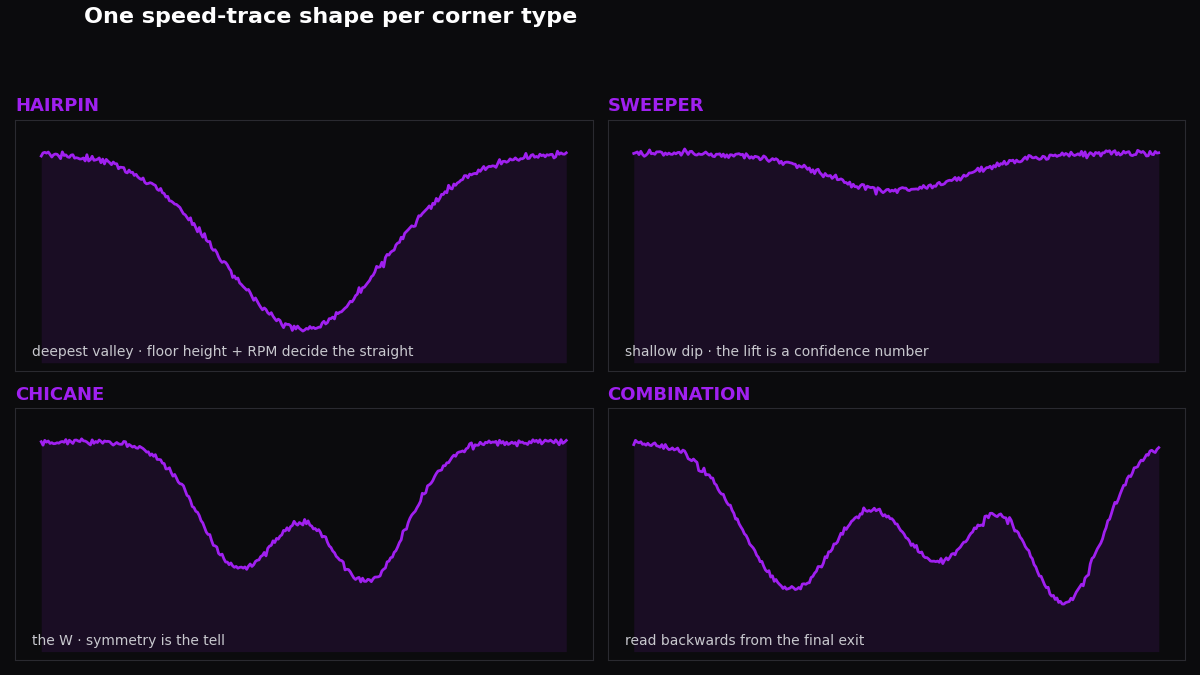
    Data signature: the deepest valley on the speed trace, and the corner where minimum RPM lives or dies. If the floor scrapes below the power band, the hairpin is being driven against the gearing, the diagnosis from kart RPM data.

    On the trace, a healthy hairpin shows one clean dip, a short floor, and revs that climb the moment the kart points straight. A struggling one shows a long flat floor and a lazy climb. That second shape is the engine telling you the straight is already lost.

    Sweepers: commitment, measured

    Fast corners flip every priority. Entry speed is the corner, and the steering does the braking.

    The reference story I tell drivers comes from Siena’s turn one, a fast ninety-degree right at the end of the straight. In 2013 I found a way to take it flat while others half-lifted. How?

    By nailing the turning point and rotating the kart aggressively while staying full throttle, inch-perfect at the apex kerb. About a tenth a lap, from one corner, and a teammate who tried to copy it without the turning point ended up in the fences.

    That’s the sweeper in one story. The corner pays commitment plus precision, and it pays nothing for either one alone. Smooth, minimal steering is the enabling skill, covered in steering technique.

    Data signature: a shallow valley, or none, and a lateral-G plateau. Progress shows as the lift shrinking lap over lap, visible in the speed trace long before the lap time moves.

    In practice the read is simple. Overlay two of your own laps through the same fast corner; the smaller dip nearly always comes with the calmer steering. The lift is a confidence number, and the trace shows exactly where it lives.

    Chicanes: the direction-change tax

    Chicanes charge you twice, once per direction, and the second change is always the expensive one.

    The attack is about the second apex. Sacrifice the first entry, arrive slightly tighter than feels natural, and prioritise a straight kart for the exit element.

    Kerbs are tools here, as much as the class and the kart allow, but the exit kerb only pays if the kart lands pointing where the power goes. A kerb that straightens the chicane is free time; a kerb that bounces the rear axle hands it all back.

    The test is simple. Take the kerb, then read the exit slope on the trace. Steeper slope, keep it; flatter, the kerb is lying to you.

    Data signature: the W-shaped double valley, and the tell is asymmetry. A first element taken too fast shows as a second element taken slow, every lap, and the overlay against a reference makes the trade obvious, per the overlay method.

    The W reads in one glance. A balanced W means the trade is working. A shallow first valley with a deep second means the first element stole speed the second had to repay.

    Combination corners: only the last exit counts

    Linked corners are where corner-by-corner thinking breaks down, deliberately.

    The rule of thumb: drive backwards from the final exit. The last corner of the sequence gets the proper line and the proper exit, and every earlier corner gets whatever entry position serves that.

    Using all the track for a rounder corner is the default everywhere else. In combinations it can be exactly wrong. The wide exit of corner one is the broken entry of corner two.

    Data signature: green-then-red sector traps. A heroic first element that poisons the second shows as adjacent sectors trading places, the reading from sector analysis.

    Backwards works on the trace too. Check the final exit speed first; if it’s down, step back one corner and check the entry, because the error usually lives upstream of where the loss shows. Walk back until you find it.

    The cash-out corner: priority overrides type

    One corner on every track outranks its own type: the one feeding the longest straight.

    Whatever shape it is, hairpin, sweeper, chicane exit, its exit speed gets multiplied by more metres than any other corner’s. This is the one place the trade-entry-for-exit advice genuinely earns its keep, the full argument in corner exit speed.

    So sort your track once: find the cash-out corner, mark it, and give it the exit-first attack even if its twin elsewhere on the lap gets driven for rotation. Same corner type, different priority, and the difference is worth real time.

    Allen Berg’s school teaches the same corner-priority sorting to its students.

    Reading your corner-type report card

    Here’s the session habit that makes the taxonomy useful instead of academic.

    After a session, group your corners by type and read each group together. All the hairpins as one question: are the floors high and early? All the fast stuff: how much lift is left?

    The chicanes: symmetric or lopsided? Grouped reading finds technique patterns that corner-by-corner reading misses, because a weakness in one corner type repeats at every track you’ll ever visit.

    Corners are local. Types travel.

    And read each group across laps, not just across corners. A type you’ve truly fixed stays fixed all session, the thread picked up in lap consistency.

    Now the homework. Sketch a map of your home track tonight, twenty minutes with a pen. Label every corner with its type, and circle the one feeding the longest straight.

    Then rank the types by where you think your time goes, and let the next session’s data grade your guesses. Don’t be surprised when it disagrees. That disagreement is the exercise doing its job, and if reading the traces is new to you, start with the karting telemetry guide.

    Fix a type and you’ve fixed it everywhere. That’s the quiet payoff, and it’s why the fast drivers practise types, not corners, with the entries built in trail braking and the lines in the racing line guide.

    FAQ

    What’s the most important corner type to master in karting?

    Hairpins, for most drivers, because karting tracks are dense with them and the engine punishes errors there hardest. But audit your own data first: the corner type costing you time at every track is your most important one, and the grouped reading above finds it in one evening.

    Then work the type, not the one corner. A single hairpin fixed is one corner at one track; the hairpin habit fixed travels with you to every circuit you race.

    Should I attack a corner differently in qualifying versus the race?

    Mostly no for technique, yes for risk. The attack per type stays; the margin you leave at the limit shrinks in qualifying and grows in lap-one traffic. Combination corners change most in racing, since defending position can force lines the taxonomy would never choose.

    One more thing for qualifying. The cash-out corner keeps its priority even on a single flying lap, because the straight after it is where the time actually arrives.

    How do kerbs change the corner-type rules?

    Kerbs are corner-specific, not type-specific: some chicane kerbs are free lap time, some hairpin kerbs unsettle the rear axle for the whole exit. Test each kerb deliberately, one change at a time, and let the exit slope in the data deliver the verdict.

    And borrow kerb lines with care. A heavier kart on a soft setup takes a kerb differently from a light one on stiff settings, so a teammate’s kerb isn’t automatically yours.

    Does corner type change with the kart class?

    The taxonomy stays, the attacks shift. More power makes V-shapes affordable in slow corners; more grip turns lifts into flats in fast ones. Re-sort the track when you change class, because last season’s flat corner might be this season’s commitment test.

    The re-sort costs you one evening with the map and one session with the data. Cheap, compared to learning it the slow way across a whole season.


    Alessio Lorandi started karting at six and won the 2013 CIK-FIA Karting World Championship. He raced through Formula 3, GP3 and Formula 2 before founding Purpl, an AI data coach for karting drivers.
  • GPS Accuracy in Karting: How Much Can You Trust Your Data?

    GPS Accuracy in Karting: How Much Can You Trust Your Data?

    Every braking point in your data, every speed trace, every track map comes from satellites eleven thousand miles overhead. It’s worth knowing how much to trust them.

    The honest answer about GPS lap timer accuracy is reassuring with footnotes. For the questions karting actually asks, where you braked, what speed you carried, where the lap differed, GPS is plenty. For a few specific jobs it wobbles, and knowing which jobs keeps you from chasing ghosts.

    Here’s the trust map, without the marketing.

    GPS lap timer accuracy guide cover with purple satellite trace on black

    Thirty seconds on how it works

    A constellation of satellites broadcasts time signals from atomic clocks. Your receiver hears several at once, measures how long each signal travelled, and triangulates position from the differences. The FAA keeps a clean explainer if you want the full picture.

    Two consequences matter for karting. Position accuracy depends on how many satellites the receiver sees and how cleanly, which is why mounting and surroundings matter. And speed comes from the change in position over time, which is why slow, tight corners are where the numbers get nervous.

    There’s also a small lag between truth and report. The receiver computes where you were a fraction of a second ago, which matters to engineers and not at all to your braking-point homework.

    What the sampling rate really buys

    The spec sheet number everyone argues about is the rate: 10 Hz versus 25 Hz, ten or twenty-five position fixes per second.

    10hz vs 25hz gps sampling comparison through a karting braking zone

    Translate it to track. At 72 km/h a kart covers 20 metres a second, so 10 Hz drops a sample every two metres, 25 Hz every 80 centimetres. That’s the entire difference: dot spacing. More dots draw sharper braking walls and catch the exact metre the trace tips over; fewer dots draw the same story slightly blurred.

    And here’s the part the spec war skips: signal quality beats refresh rate. A clean 10 Hz receiver, mounted well under open sky, produces more trustworthy traces than a 25 Hz unit by the ignition coil. Rate sharpens a good signal. It cannot rescue a bad one.

    What GPS answers confidently

    The good news list is long, and it covers most of this blog.

    Braking points land within a couple of metres at 10 Hz, sharper at 25, which is precise enough to settle any tent argument. Speed traces, minimum speeds and exit slopes are dependable everywhere the kart moves quickly. Lap and sector times from a GPS gate are consistent to small fractions of a second, and consistency is what comparison needs. Track maps and line comparisons hold to roughly a kart’s width, enough to see line differences that matter in wet sessions.

    In short: every reading method in the speed trace guide and the overlay method works at 10 Hz. I’d rather see a driver read a 10 Hz trace properly than own a 25 Hz unit as a stopwatch. The argument settles itself the first evening you overlay two laps and watch the braking points line up, metre for metre.

    Where it wobbles, and why

    Four honest weaknesses, all with workarounds.

    Hairpin speed. At walking-pace corner speeds the position change per sample is tiny, so the speed calculation gets noisy and the valley floor turns ragged. Read slow-corner minimums as a band, not a decimal. Absolute position drift. The whole track map can sit a metre or two offset from reality day to day; shapes and comparisons survive, painted-kerb-level precision doesn’t.

    Obstructions. Trees, walls, grandstands and bridges briefly degrade the fix, and indoor karting kills it entirely; that’s transponder territory, covered in how lap timers work. And installation. A receiver flat under open sky behaves; one shadowed by the driver or near the ignition lead invents adventures, the failure mode from lap timer troubleshooting.

    The mounting rules that buy you accuracy for free

    Three rules, all cheap, all worth more than a spec upgrade.

    Sky view first. The receiver wants the widest view of the sky you can give it, flat, not tucked under the front fairing and not shadowed by your torso. Distance from noise second: route the GPS away from the ignition lead and coil, the two great liars of kart wiring. And rigidity third, because a unit shaking on a loose mount smears every sample it takes.

    I’ve watched a kart’s “engine problem” vanish when the logger moved ten centimetres. Not because the engine changed. Because the data stopped lying about it. Ten centimetres. Free.

    Five minutes with a bracket beats a hundred euros of refresh rate. Do the five minutes first.

    GPS versus the alternatives

    Karting times laps three ways, and they’re complements, not rivals.

    Track transponders are the official clock: race results, protests, the championship table. Magnetic strips trigger old-school onboard timers reliably but say nothing about the lap between beeps. GPS owns everything in between, the entire shape of the lap, which is why it carried the whole data analysis stack in the first place.

    So the practical setup is boring: race on the transponder, learn on the GPS. If your logger supports a beacon or strip as the lap trigger alongside GPS, use it for cleaner lap splits; if not, a well-placed GPS gate is fine. Your buying decision rarely hinges on timing tech anyway, as the lap timer market guides like Your Data Driven’s point out: it hinges on what you’ll actually review.

    The five-second trust check

    Before believing any session’s data, I run three glances. They catch nearly every GPS lie.

    Lap distance: does the data’s lap length match the track’s published length, within a few metres, lap after lap? Satellite count, if your software shows it: a session that dipped to a handful of satellites will show it in the traces. And the ratio check from kart RPM data. On a single-gear kart, speed divided by RPM should hold steady, and GPS noise shows up as the speed side of that ratio twitching.

    Pass all three and trust the session. Fail one and fix the install before drawing a single conclusion, per mistake ten of data analysis mistakes.

    Do you need 25 Hz?

    My buying advice, from experience rather than spec sheets. Short version: probably not yet.

    If you’re choosing between two units and the price gap is small, take the higher rate; sharper braking walls are a real, visible benefit. If upgrading means real money, spend it on seat time or tyres instead, because no reading in this blog’s method requires more than a clean 10 Hz. If you’re choosing a first logger, weigh screen, software and support above the rate, because the unit you enjoy reviewing is the unit that gets reviewed. And if your current data looks noisy, fix mounting and sky view first. Most “my GPS is inaccurate” complaints I’ve seen were installation complaints wearing a spec-sheet costume.

    Sampling rate is the last tenth of data quality. The first nine are whether you open the file at all.

    A note on predictive lap timing

    One GPS feature deserves its own caution: the live predictive lap time, the running plus-minus on the dash.

    Technically it’s impressive, and accurate enough to trust. That’s exactly the problem. A live delta on the dash invites your brain to do maths instead of driving, the trap I covered in delta time. And no hertz rating fixes a lap you talked yourself out of mid-corner.

    Use the predictive screen in testing if it helps you bisect a setup change. Hide it in qualifying. The satellites will still be there after the flag. So will the maths.

    FAQ

    How accurate is a GPS lap timer for lap times?

    Consistent to a few hundredths against itself, which is what analysis needs. It won’t always match the official transponder to the digit, because the timing lines differ, but it will rank your laps and measure your gaps faithfully. Use transponder times for results, GPS for everything between. That self-consistent ranking is what every method on this blog actually runs on.

    Is 25 Hz worth it over 10 Hz?

    It’s a real improvement in braking-zone sharpness and slow-corner smoothness, not a revolution. Clean mounting and open sky matter more. Buy 25 Hz happily in a new unit; upgrade an installed, working 10 Hz unit only when something else justifies the change.

    Why is my speed trace ragged in hairpins?

    Low speed means tiny position changes per sample, so the computed speed jitters. It’s physics, not a fault. Read slow corners as shapes and bands, and let your software’s smoothing help, as covered in the speed trace guide’s FAQ.

    Does GPS work for indoor karting?

    No, roofs block the satellites. Indoor timing runs on transponders and loops, and your data layer indoors is the venue’s timesheet plus your own consistency work. Outdoor karting is where the GPS analysis stack lives.


    Alessio Lorandi started karting at six and won the 2013 CIK-FIA Karting World Championship. He raced through Formula 3, GP3 and Formula 2 before founding Purpl, an AI data coach for karting drivers.

  • Kart Tire Pressure: Finding Your Optimum With Data

    Kart Tire Pressure: Finding Your Optimum With Data

    Tire pressure is the adjustment you’ll touch most in karting. And the one most people set by superstition.

    Here’s the truth that reorganises everything: kart tire pressure is not a number you find once. It’s how you steer tyre temperature into its window on a track that changes by the hour.

    The number moves. The method for finding it doesn’t.

    This is that method, with the story that taught me to distrust every printed target.

    Kart tire pressure guide cover with purple pressure-temperature curve on black

    Pressure is a thermostat, not a setting

    What you’re actually tuning is temperature. The tyre manufacturers name an optimal temperature range, say 80 to 85°C for a racing slick. Pressure is your main lever for how fast the tyre gets there and where it settles.

    Higher pressure heats faster and peaks sooner. Lower pressure takes longer to wake up and holds on later into a stint. That single trade explains almost every pressure decision in karting, from the qualifying setup that fires immediately to the race setup that’s still alive at the flag.

    That’s the whole game.

    The community guides agree on the mechanics, KartClass’s tyre pressure guide and FlowRacers’ quick reference both walk it well. What they can’t give you is your number for this track, today. That’s the data’s job.

    The story that killed the printed target for me

    The tyre supplier may tell you the ideal hot target is, say, 0.90 bar. And on a cold winter day, it may be exactly right.

    Then comes a hot, grippy summer day, track temperature in the fifties, rubber layered down, big classes running two wheels at the kerbs. Run the printed 0.90 there and after two laps you start sliding, and your lap times get worse while everyone else’s improve. The real target that day might be 0.80, even 0.75.

    Same tyre, same kart, same manufacturer. Different day, different number.

    Which is why the advice I give every driver is the one I follow myself. Experiment on every new track, every changed day, and let tyre data and lap-time progression name the target. The printed number is where the experiment starts, never where it ends.

    Finding your kart tire pressure with data

    The method needs a gauge, a logger, and honesty. Three reads per session. If the logger side is new to you, start with the karting telemetry guide and come back.

    Go kart tire pressure stint read: lap time progression shows pressures too high, right, too low

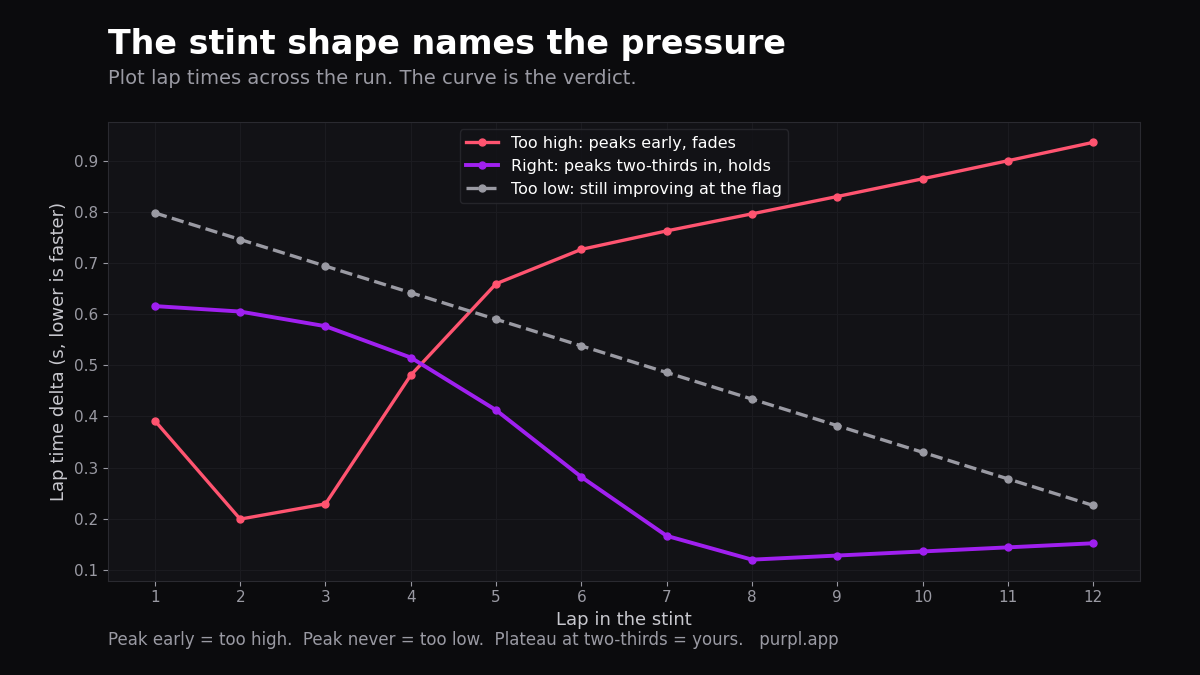
    The stint shape. Plot your lap times across the run. Peak in the first three laps then fade: pressures too high, the tyre overshot its window.

    Still improving on the last lap: too low, the window arrived as the session ended. Peak around two-thirds into a race run, holding a plateau: that’s the shape you’re hunting.

    The cold-to-hot delta. Log cold pressure before the run and hot pressure the moment you’re in. The difference tells you how much heat the tyre built, and a delta that swings session to session means conditions moved and your starting number should too.

    The corner evidence. Minimum speeds early versus late in the stint, and the consistency spread by stint phase, per lap consistency. A kart that’s quick at lap two and three tenths slower at lap ten is telling a pressure story before it’s telling a driving one.

    Log all of it in the session sheet, the routine from the data starter sheet. Within a few weekends you own a pressure map for your tyre, your kart, your tracks.

    Here’s how a pressure day actually runs. Saturday morning, green track, air still cool. You set the supplier’s baseline cold, write it in the sheet, and go run the stint.

    The download shows the lap times still improving when the session ended. Too low. The window arrived late for these conditions, so the next run starts a touch higher, and only the pressures change between the runs, nothing else on the kart gets touched.

    By the afternoon the picture flips. Rubber has gone down, more classes have run, and the surface is grippier every session. The same starting pressures now peak early and fade, so you step back down for the next run and let the stint shape confirm the move was right.

    Rinse and repeat.

    Notice what never happened. No guessing. No copying the kart next door.

    Every move came from a read you can repeat next weekend, the same loop as the wider data analysis routine: measure, change one thing, measure again, week after week.

    Numbers for orientation, not religion

    Ranges, honestly framed. Most racing slicks live somewhere around 0.55 to 0.90 bar cold, roughly 8 to 13 psi. Your class, tyre compound and supplier bulletin narrow it from there.

    Rental karts run higher. Wet tyres run higher again, because standing water cools and the tyre needs help building temperature.

    Your tyre supplier’s recommendation and your team’s baseline outrank any article’s range, including this one. The data method above is how you move off the baseline with evidence instead of paddock gossip.

    And condition shifts have directions worth memorising. Hotter track, more rubber: start lower. Cold morning, green track: start higher.

    Long final versus short qualifying: lower still, so the window arrives mid-race instead of lap two, the same logic FlowRacers frames for race conditions.

    Front and rear don’t have to match, either. Plenty of drivers run the two axles at slightly different pressures, because each axle does a different job. The fronts shape turn-in and steering feel, the rears shape traction and stability under power.

    So a kart that turns in lazily can respond to a small change at the front alone. A nervous rear can calm down with its own change at the back.

    Some teams go further on circuits where one side of the kart works harder than the other. They trim individual corner pressures a fraction, so all four tyres build temperature evenly.

    Qualitative moves, all of them. No magic. The stint shape and the gauge still decide whether they helped.

    The discipline that makes pressures comparable

    Pressure data is only as good as its measurement habits, and two rules carry most of it.

    Own one decent gauge and trust only it, because gauges disagree with each other more than setups do. And measure at consistent moments: cold before the out lap, hot immediately on return, because five minutes of cooling rewrites the hot number and quietly corrupts your map.

    One gauge, two moments. Every session.

    One change at a time, as everywhere in kart setup. Pressure changes are fast and cheap, which makes them the easiest place to change two things at once and learn nothing.

    When pressure isn’t the problem

    The honest section. Pressure gets blamed for everything because it’s the adjustment everyone can reach.

    A kart that slides all stint on sensible pressures has a setup or driving question, not a pressure one. Track grip moving by the hour mimics pressure problems perfectly, the trap mapped in track grip evolution.

    And tyre temperature spread across the four corners of the kart, where you have temps from the sensor stack, is a separate tell. It points at setup and driving long before it points at the gauge.

    The stint-shape read protects you here: pressure problems follow the heat cycle, setup problems don’t care what lap it is.

    Heat cycle first. Then everything else.

    FAQ

    What pressure should my kart tires be?

    Start from your tyre supplier’s recommendation for your compound and class, usually landing inside the broad 0.55-0.90 bar cold range for slicks. Then run the stint-shape method and let the data move you off the baseline. The right answer is a method, not a constant.

    And write the number down with the day’s conditions, every time. A baseline only becomes yours once you’ve tested it against a hot afternoon and a cold morning on the same tyre.

    Why does my kart get slower after a few laps?

    Classic too-high signature: the tyre overshot its temperature window and the grip walked away. Drop the starting pressures a step and reread the stint shape. If the fade survives sensible pressures, look at setup and driving inputs instead.

    Check the boring things too, before blaming the tyre. A gauge that disagrees with last week’s, or a hot reading taken late, can fake the same signature and send you chasing a problem you don’t have.

    Should pressures differ between qualifying and the race?

    Usually yes. Qualifying wants the window in the first flying laps, so start higher. Races want it arriving mid-stint and staying, so start lower.

    The exact split is your kart and tyre’s answer, found in two back-to-back tests. Run them on the same day with everything else frozen, and the stint shapes will name the split better than any rule of thumb, this article’s included.

    Do I really need to log pressures every session?

    It’s thirty seconds, and it’s the difference between a pressure map and a pressure mythology. Cold, hot, conditions, stint shape. A month of rows answers questions that years of paddock opinions never will.

    The habit pays off fastest on the weekends that go wrong. When the kart suddenly feels strange, the sheet tells you whether the pressures moved or the track did. That one answer saves an afternoon of guessing.


    Alessio Lorandi started karting at six and won the 2013 CIK-FIA Karting World Championship. He raced through Formula 3, GP3 and Formula 2 before founding Purpl, an AI data coach for karting drivers.
  • EGT in Karting: Using Exhaust Temperature Data to Jet Right

    EGT in Karting: Using Exhaust Temperature Data to Jet Right

    Every two-stroke karter lives between two fears. Too rich, and the engine is soft, dirty, slow. Too lean, and somewhere out there a seizure is waiting with your name on it.

    The kart EGT sensor exists to manage exactly that trade. A probe in the exhaust reads the temperature of the burn, and the burn tells you where your carburetion really is, lap after lap, corner after corner.

    It’s the carburettor’s thermometer, and at serious level it’s not optional anymore. Here’s how I read it, including the two traps that catch almost everyone.

    Kart EGT guide cover with purple exhaust temperature trace on black

    What the probe actually measures

    The sensor is a thermocouple sitting in the exhaust header, close to the cylinder. It reports the temperature of the gas leaving the engine, many times a second, straight into your logger.

    The chemistry is simple enough to trust. A richer mixture burns cooler, because the extra fuel soaks up heat. A leaner mixture burns hotter, right up to the point where hot becomes dangerous.

    Why does extra fuel cool the burn? Because fuel has to turn to vapour before it burns, and that change eats heat. Run lean and there’s less fuel doing that job, so more of the heat of the burn stays in the gas on its way past the probe.

    So EGT moves opposite to fuel. Temperatures climbing means mixture leaning, and your margin shrinking. That’s the whole principle.

    The skill is in which numbers you watch, and when you’re allowed to believe them.

    Reading kart EGT: two numbers, not one

    The biggest beginner mistake here is reading one temperature. It’s two.

    EGT sensor kart trace showing separate bottom and top carburetion windows across a lap

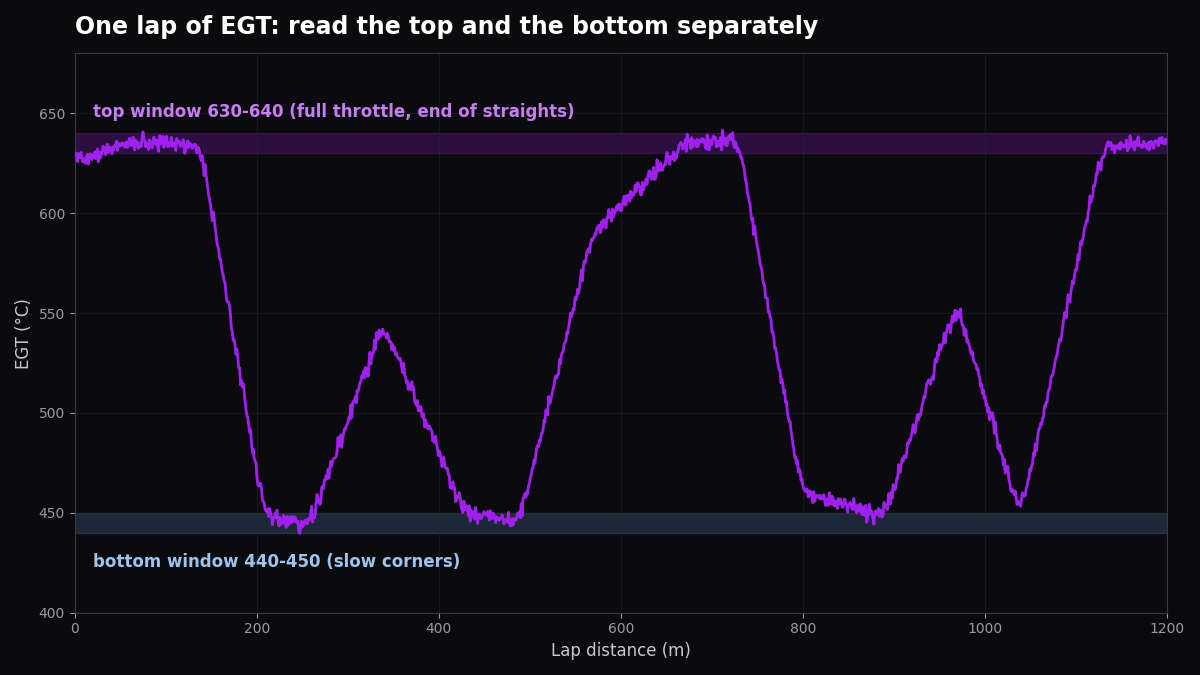
    The maximum, reached at full throttle down the straights, describes your carburetion at the top of the rev range, and the minimum, in the slow corners, describes the bottom.

    They answer different questions. They’re tuned by different adjustments. And they need to be logged separately, never averaged.

    The targets come from your engine tuner’s dyno hours, and they’re specific to your engine and fuel. To give you the shape of it with our numbers: a window of say 630 to 640 degrees at the top. Not so rich you lose power, not so lean you risk seizing.

    And say 440 to 450 at the bottom; once the tuner names them, those values become the north star, exactly like the 50 degrees of water temperature.

    Treat those as examples of the framing, not as your targets. Your tuner’s numbers beat mine, every time, and the wider window idea is mapped in kart sensors explained.

    Now make it practical. Say your tuner names the windows, and your straight-end maximum starts creeping above the top one. That’s a lean warning at high revs, even if the bottom number is still sitting pretty.

    Or say the bottom number sits low while the top is fine. That’s a rich bottom end: dirty pickup off slow corners, nothing dangerous, just slow.

    Two numbers. Two separate conversations with the carburettor.

    The driving-style trap

    Here’s the trap that wastes the most carburettor adjustments in any paddock. By a distance.

    EGT lines are heavily driving-style related. Two karts with identical carburetion will draw different EGT traces if the drivers pick up the throttle at different points. The burn follows the right foot as much as the fuel.

    I’ve sat with drivers convinced their jetting was wrong because their EGT line split from their teammate’s. Then I showed them. Wherever both karts went to throttle at the same moment, the temperatures matched exactly.

    So the comparison rule is strict. Judge carburetion against another kart only where the throttle behaviour matches, ideally at the end of the straights where everyone is flat.

    Mid-corner EGT differences are usually driving differences wearing a carburettor costume, and they’re the same confusion filed under mistake seven in my list of data analysis mistakes.

    The drift that seizes engines

    Carburetion isn’t a set-and-forget number across a race. It drifts, and the drift has a direction.

    As laps go by and grip comes up, the driver naturally gets on the throttle earlier and harder. More throttle time means the mixture runs effectively leaner and leaner. In categories like OK and KZ2, that drift is exactly how engines get seized in the final third of a race.

    The EGT trace shows it as a ceiling that creeps upward, lap after lap.

    Which is why starting slightly rich is the classic race setup: you suffer a dirty first response early, and the engine cleans up as the race leans it. The sweet spot arrives mid-race instead of the danger zone arriving at the flag.

    Start lean and the same drift works against you, with much worse failure modes. Rich is patient. Lean is not.

    What does a healthy stint look like on screen? Peaks that sit inside the window and stay put, lap after lap, maybe edging up a touch as grip builds. Boring is good here.

    An unhealthy stint is a staircase. Each lap’s peak a little higher than the last, no flattening, and the minimum climbing with it. When the whole trace migrates upward together, blame the mixture, not the driving.

    Watch the trend across the stint, not just the lap. A rising EGT ceiling is the engine telling you tomorrow’s jetting, and the hardware levers live in jetting by the numbers.

    The ear test still works

    One old-school habit I refuse to retire, even with a perfect EGT trace on the dash.

    You can hear a lean engine. The sound shifts, gets just a bit too loud and hard-edged, and that note told me more than once that the engine was struggling toward the edge of seizing.

    The response is immediate and free. Richen the carburetion, or do the ancient karting move of putting a hand over the carb down the straight to force it richer for a moment.

    The sensor confirms what the ear suspected, a few seconds later, in degrees. Use both. The ear is real-time and the probe is precise, and the combination is how two-stroke drivers survive hot afternoons.

    Can you train the ear? Yes, and the safe way is to practice on days when you know the engine is rich. Learn the round, slightly flat note of a fat mixture on those safe days, so the hard edge of a lean one stands out the moment it appears.

    Listen in the same place every lap, ideally the second half of the main straight. And use the ear in one direction only. A suspicious note earns a richer setting or a hand over the carb, never a leaner one.

    Setup and comparison discipline

    Three habits make the channel trustworthy.

    First, mount the probe at the distance your engine builder specifies. Never compare absolute EGT numbers with a kart whose probe sits at a different distance. Placement changes the reading.

    Second, log minimum and maximum separately in your session sheet, the routine from the sensors hub. Third, when something looks wrong, check the basics. A loose probe or tired connector draws drama better than any real problem, per installation discipline.

    Here’s my session routine for this channel. Glance at the dash max on the in-lap. Then write two numbers in the sheet before anyone touches the kart: the EGT maximum and the minimum.

    That’s it. Do it after every run, morning practice included. No exceptions.

    The early numbers look harmless, but grip builds through the day, throttle time grows with it, and the same lean drift quietly works across the whole day too.

    Cross-check the straight-end reading against revs while you’re at it. EGT and RPM read together tell you whether the engine is healthy and pulling, the pairing I walk through in kart RPM data.

    For the practical carburettor side, TKART’s carburetion tools guide is solid. And the KartPulse EGT and carburetion thread shows real drivers working through real traces, useful calibration for what normal confusion looks like.

    EGT or lambda?

    Honest answer: I prefer lambda, because it measures the mixture directly instead of inferring it from heat, and the information is simply more accurate.

    But EGT is cheaper, tougher, and everywhere, which is why it remains the standard tuning channel in most paddocks. Run EGT until your programme is serious enough to want the sharper tool, then read the lambda sensor guide before spending. Plenty of top tents run both and let them check each other.

    FAQ

    What should my kart EGT be?

    Whatever your engine builder’s dyno work says for your engine, fuel and pipe, read as separate top and bottom windows. Published numbers vary too much across classes and probe placements to borrow safely.

    If you have no tuner numbers yet, log a known-good session and treat it as your baseline. Then judge every later session against that baseline. The trend is the information.

    Why does my EGT differ from my teammate’s with the same jetting?

    Almost always driving style: different throttle pickup points produce different burns from identical carburettors. Compare only where you’re both flat out.

    If the numbers still differ at the end of the straight, check probe placement before touching a jet. Same engine, same fuel, same probe distance: only then do the absolute numbers earn a conversation.

    Is a falling EGT at full throttle good news?

    Usually the opposite of what it looks like. If peak temperatures sag while everything else is constant, don’t celebrate. Suspect the reading or the engine: a tired probe, a connector, or combustion that’s gone wrong.

    Investigate before the next session, not after. Sensors fail far more often than engines, so start at the cheap end of the list.

    Does EGT replace the water temperature channel?

    No, they watch different systems. EGT guards the mixture, water temp guards the cooling, and a hot day can push both for different reasons.

    The pairing, plus RPM, is the core two-stroke dashboard, as covered in the karting telemetry guide. Read them together at the end of each session, next to your lap times, and the engine has very few ways left to surprise you.


    Alessio Lorandi started karting at six and won the 2013 CIK-FIA Karting World Championship. He raced through Formula 3, GP3 and Formula 2 before founding Purpl, an AI data coach for karting drivers.

  • The Racing Line in Karting, Explained With Telemetry

    The Racing Line in Karting, Explained With Telemetry

    Ask anyone in a paddock to explain the racing line and you’ll get the same speech. Enter wide, clip the apex, exit wide. It’s correct, as far as it goes.

    But it’s also the explanation drivers receive at eight years old and then never upgrade, which is why so many of them argue about lines using feelings. Their own GPS data could settle the question in thirty seconds.

    So let’s do the upgraded version: the geometry, what the data actually shows, and the cases where the textbook line is the wrong line.

    Racing line in karting explained with telemetry cover graphic

    The geometry: radius buys speed

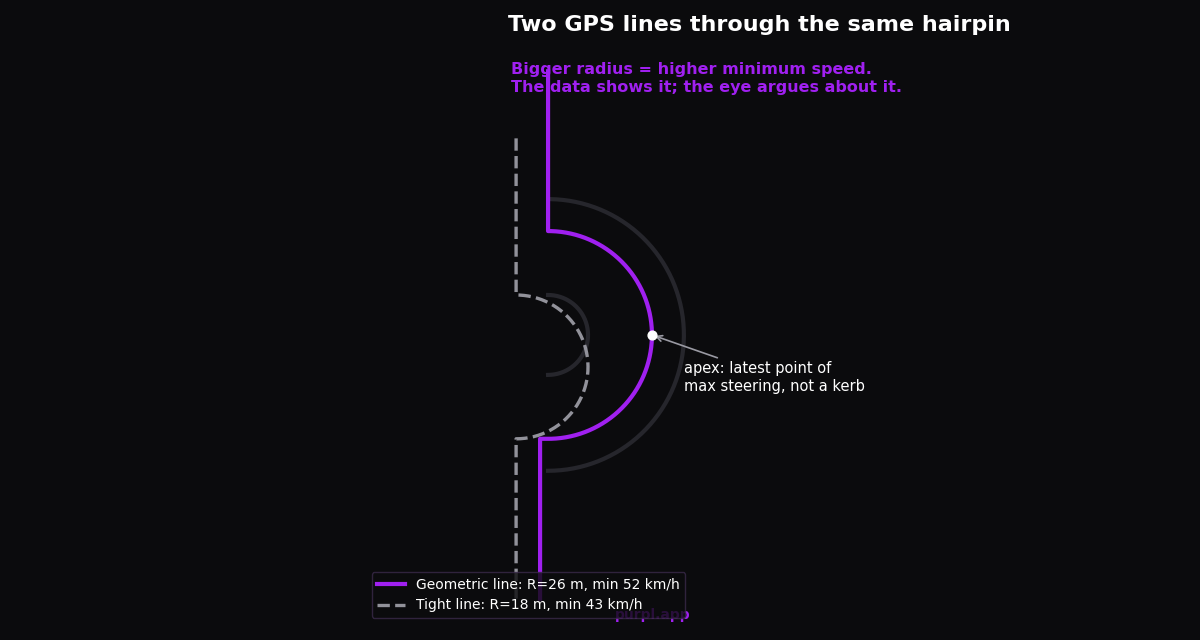
    A kart’s cornering speed is limited by grip. And for a given grip level, speed rises with the radius of the arc you’re driving.

    That’s the entire physics of the racing line. Use the full width of the track to drive the largest radius the corner allows, and you carry the highest minimum speed through it.

    GPS comparison of two racing lines through a kart hairpin showing the larger radius carries 9 km/h more

    In the GPS overlay above, the wide geometric line is worth 9 km/h of minimum speed over the tight line through the same hairpin. Nine.

    That dwarfs almost anything you can do with braking heroics. And it’s why minimum corner speed is the first number I check in any driver’s data, a habit explained in the speed trace guide.

    The apex, by the way, is not a kerb. It’s the point where your steering is at maximum and the corner starts opening. And its position is a choice.

    Late apex: slower in, faster out, the corner exits onto a straight. Early apex: more entry speed, compromised exit, sometimes correct before a short gap to the next corner; corner-by-corner logic for that choice is in karting corner types.

    What the data adds to the theory

    Here’s why I insist on the telemetry version of this topic. The eye is a terrible judge of lines.

    Two laps can look identical from trackside while the GPS shows half a metre of difference at the apex and 3 km/h of minimum speed between them. Drivers will swear they used the full exit width; the data shows a metre of unused track, every lap, for a whole session.

    A metre of track is radius. Radius is speed.

    So the workflow: overlay your line against a faster reference in the corner where you’re losing time. Then look at three places.

    Entry width, are you actually starting from the outside edge? Apex position, earlier or later than the reference? And tighter or freer?

    Exit width, did you use everything?

    Then cross-check against the speed channels, because the line is only a means. The verdict is always minimum speed and exit speed. The full overlay method is in comparing two laps.

    The five reference points of every corner

    To work on lines systematically you need vocabulary, because “I took it better” isn’t analysable. Every corner has five points worth naming. And your GPS line shows all of them.

    The braking point, covered fully in the braking guide, sets up everything after it. A wandering braking point makes the other four points wander with it.

    The turn-in point is where your line commits, and it’s the most underrated of the five: turning in two metres early is the most common single line error in karting. And it forces an early apex and a pinched exit even if everything else is perfect.

    The apex we’ve covered.

    The throttle point, where you return to full power, should generally arrive at or just before the apex in slow corners; the data check is brutal and simple. Look where your speed trace stops falling and starts climbing.

    And the track-out point, the spot where the kart reaches the exit edge, tells you whether you actually used the radius you paid for. Five points, five checkable facts per corner, and suddenly a vague feeling becomes a list.

    Kerbs: free radius, with conditions

    Kerbs extend the track, and at most circuits the fast line uses them. The conditions: a kart takes flat kerbs and low rumble strips happily. But tall serrated kerbs unsettle the rear, and can lift the inside rear at exactly the moment you need it driving.

    Apex kerbs are usually worth more than exit kerbs, because radius at the apex raises minimum speed, while exit kerbs mostly add safety margin. Wet kerbs are painted ice. Stay off.

    And test kerb use the same way you test everything. With the trace open. A kerb that feels dramatic and costs a tenth shows up immediately in the minimum speed, the check described in the data analysis method.

    When the textbook line is wrong

    The geometric ideal assumes a corner in isolation, even grip, and nobody else on track. All three assumptions break regularly.

    Corners in sequence: the rule is to optimise the exit of the last corner of a sequence onto the straight, sacrificing the ones before it. A perfect first chicane apex that leaves you wrong-side for the second is a beautiful mistake.

    Grip isn’t where the textbook puts it: rubber builds where karts run, and off-line is dust and marbles early in a weekend. Then sometimes the inside line is faster late in a meeting, simply because it’s rubbered from defending. Reading this evolution through your data across sessions is its own skill, covered in track grip evolution.

    In the wet, everything inverts and the dry line becomes the slow line. That special case has its own article, karting in the rain.

    Race lines: when slow on purpose is fast overall

    Everything above optimises a lap in clean air. Races add opponents. And opponents change the optimisation.

    Three situations where the “wrong” line is right.

    Defending: the inside line into a braking zone is slower by maybe a tenth. And it makes you un-passable into that corner. Whether to pay that tenth depends on who’s behind and how many laps remain.

    That’s arithmetic, not bravado. Pay it on the corners that lead onto overtaking straights. Driving defensively everywhere just makes you slow with extra steps.

    Attacking: an overtaking line borrows entry width from your exit. The skill is knowing, from your own data, exactly how much exit you’re sacrificing, so the move either completes or wasn’t attempted.

    Drivers who “almost” pass five times a race are usually spending two tenths per attempt. The accounting is in overtaking in karting.

    Dirty air and tow: following closely costs front grip in fast corners and pays back on straights. At tracks with long straights, the leader’s ideal line matters less than the follower’s tow.

    That’s why the last lap of a kart final looks nothing like a qualifying lap from either driver. Plan your final-lap line in advance. Everyone fast does.

    Your eyes draw the line

    Here’s the part of line driving that never shows up in geometry lessons. The kart goes where your eyes have already been.

    Look at the apex and you’ll drive to the apex. Stare at the kerb you’re afraid of and you’ll meet it. The technical name is target fixation, and every coach has watched it steer a kart into the one hazard the driver was trying to avoid.

    The discipline is to keep your eyes one reference point ahead of the kart. Approaching the braking point, your eyes are already at turn-in. At turn-in, they’re at the apex.

    At the apex, they’re at the exit. It feels unnatural for exactly the first hour, and then it becomes the thing you can’t believe you drove without.

    The data shows the change indirectly but unmistakably: steering corrections drop, and the mid-corner double-dips disappear from the speed trace. And the line through any corner becomes one clean arc instead of three negotiated segments.

    A simple test for whether your eyes are the problem. Can you name the colour or shape of your turn-in reference at three different corners of your home track?

    If you can’t, you’re driving by feel. And your line will wander with your mood.

    Fast drivers have named references everywhere. It’s the least glamorous secret in the sport.

    Homework for your next session

    Pick two corners, one fast, one hairpin. Walk to each before driving. Choose physical references for turn-in and apex.

    Drive the session using them, eyes always one point ahead. Then download and overlay against your previous best. Check two numbers per corner: minimum speed and the width you actually used at exit.

    That’s a complete line-training session. It costs nothing. And it beats five sessions of driving around hoping.

    Line errors I see most in coaching

    Three patterns cover most of what I correct at junior level.

    Entry laziness: starting the corner from a kart-width inside the edge, instantly shrinking the available radius, costing speed before the driver has done anything else wrong.

    Apex worship: treating the painted kerb as a target in itself and steering twice to hit it, when one smooth arc with a free apex would carry more speed. You can hear this mistake in the steering, and see it in the data as a double dip in mid-corner speed, the signature explained in what steering data reveals.

    And exit modesty: lifting the kart off the exit kerb it should use, donating that last metre of radius back to the track.

    Each one is invisible to the driver and obvious in the overlay. That’s the recurring theme of this whole series. Feel argues, data decides.

    Learning lines faster

    When you arrive at a new circuit, don’t try to derive the perfect line from first principles on lap one. Watch where the rubber is. It’s the previous drivers’ data written on the asphalt.

    Follow someone fast for three laps before you’ve built bad habits. Then download and check your minimum speeds corner by corner against whatever reference you can get; the complete arrival routine is in how to learn a new track fast.

    One last opinion, since this series doesn’t do neutral conclusions: most drivers spend their line-learning effort on the spectacular corners, the fast sweepers, and leave the slow hairpins on autopilot. Backwards.

    Slow corners are where radius differences turn into the biggest time differences, because you spend so long in them. Learn the boring corners first. The data agrees with me, and the maths of why is in the braking-cost comparison from the braking technique guide.

    And remember the order of operations. Line first, then braking refinement, then setup.

    A clean line makes every other improvement measurable. A dirty one buries them all in noise.

    For broader cornering theory from the car world that holds up in karting, the line geometry explainers at Driver61 are well made. And the karting-specific technique discussions at TKART include line case studies with data.


    Alessio Lorandi started karting at six and won the 2013 CIK-FIA Karting World Championship. He raced through Formula 3, GP3 and Formula 2 before founding Purpl, an AI data coach for karting drivers.
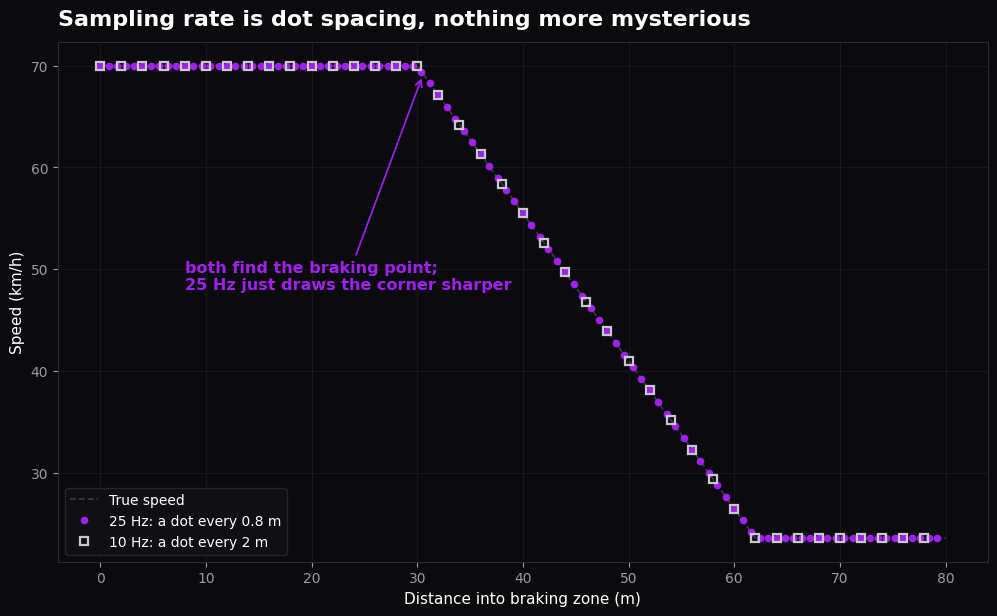
  • 10 Data Analysis Mistakes Karting Drivers Keep Making

    10 Data Analysis Mistakes Karting Drivers Keep Making

    The hardware is fine. In fifteen years of reading kart data, mine and other people’s, I can count the genuinely broken loggers on one hand.

    The reading is the problem. The same data analysis mistakes appear in karting paddocks every single weekend, at every level. Most of them cost more lap time than the driving errors they were supposed to find.

    Here are the ten I see most, each with its escape route. Count how many are yours. My own worst-season score was four, so no judgement here. The list is cheap to read and expensive to ignore, because every mistake on it compounds quietly until the day the material is equal and the excuses run out.

    Data analysis mistakes karting drivers make, cover graphic with purple warning trace

    Why these mistakes cost so much

    A driving mistake costs you a corner. A reading mistake costs you the whole project, because every session afterwards chases the wrong problem.

    Blame the engine for an exit problem and you’ll spend a month of tuning on a braking habit. Trust a slipstreamed reference and you’ll chase a deficit that never existed. The data was right both times. The reading sent the work in the wrong direction, and that’s why this list earns its place next to any technique article on this blog.

    Checklist card of ten telemetry mistakes karting drivers keep making

    1. Using the logger as a stopwatch

    Glance at the lap time, feel good or bad, go home. The most expensive habit in karting, because the hardware gets blamed for being useless when it was never opened.

    The escape is one evening: put two laps on top of each other and watch where the time actually lives. That first overlay converts more drivers than any article, and the karting telemetry guide is the on-ramp.

    2. Opening every channel at once

    Twelve traces, zero conclusions. Drowning looks like diligence.

    Three channels in a fixed order find almost everything: delta to locate, speed to diagnose, RPM to confirm. The full reading order is in how to analyze kart racing data.

    3. Skipping the delta entirely

    The one line that answers “where am I losing time” is the one most drivers never open. They scroll speed traces looking for vibes instead.

    Delta first, always, then the other channels only where it moved. Five minutes with delta time replaces an hour of scrolling.

    4. Comparing laps across different grip

    Friday’s lap against Sunday’s, or a 9am lap against the rubbered 2pm final. The comparison measures the track, not you.

    Grip moves by whole tenths as rubber goes down, so references come from the same session, full stop. Cross-session comparisons are for shapes only, never numbers, per the rules in comparing two laps.

    5. Trusting a contaminated reference

    The teammate’s “fastest lap” had a tow down both straights. Now your engine looks slow and his driving looks divine, and neither is true.

    Check the reference before you copy it: was it slipstreamed, was it one banzai corner, can he repeat it? A reference lap is a measuring stick. Bent stick, bent conclusions.

    6. Blaming the engine for an exit

    The classic. A 1.5 km/h deficit at the end of the straight, and the tent declares the engine dead.

    Trace the plateau backwards and the deficit usually starts at the corner exit, then rides the whole straight. Most “engine” problems in karting data are exit problems wearing a disguise, the diagnosis from kart RPM data.

    7. Misreading EGT as carburetion

    Two EGT lines split, and someone announces the jetting is wrong. But EGT follows the right foot as much as the fuel.

    Two drivers picking up the throttle at different points produce different EGT lines on identical carburetion. Compare the temperatures where the throttle behaviour matches, or you’re tuning the carburettor to fix a driving style.

    8. Wearing the excuses hat

    Some drivers open the data to find the problem. Others open it to find the proof that the kart was the problem.

    The excuses hat finds its evidence every time: 100 missing RPM, a temperature one notch off, anything except the four metres of braking left on the table. Data is a mirror, and if you’re not willing to look at yourself in it, the laptop is a very expensive comfort blanket.

    9. Letting the data drive for you

    The opposite failure, and the one I warn the strongest drivers about. Copying a teammate’s braking points from the overlay instead of building your own feel for them.

    I see it at WSK weekends: kids who can’t find a braking point on their own because the reference lap always found it first. Telemetry is backward-looking; the moment grip changes, the file is history and your internal references are all that’s left. The data should sharpen them, never replace them.

    10. Analysing garbage without noticing

    Loose logger mount, GPS antenna by the ignition coil, a magnet strip the software doesn’t know about. The traces still draw beautifully. They’re fiction.

    Sanity-check before trusting: does the lap distance match the track, does the ratio of speed to RPM hold steady, do the G numbers pass the smell test? Five seconds of suspicion per session, detailed in GPS lap timer accuracy.

    How to spot your own mistake

    Reading a list is easy. Catching yourself mid-mistake is the skill, so here are the tells.

    If your sessions end with a feeling instead of a sentence, you’re in stopwatch mode. If your analysis evenings run long but next session has no single change attached, you drowned in channels. If your conclusions usually flatter you, check which hat you’re wearing, because the detective’s verdicts sting about half the time.

    The monthly read-back of your debrief sheets catches the slower drifts too, the mistakes that creep in across a season rather than a session. Reading your own March verdicts in June is humbling in a useful way.

    And there’s a tell for the whole tent, not just the driver.

    Count how often the conclusion is something nobody in the tent can act on, weather, engine lottery, the other kids’ rich fathers. A healthy debrief produces actions. An unhealthy one produces explanations.

    The cure for all of it is embarrassingly small. One question before the session, written down. Everything in the reading then has a job, and readings with jobs don’t wander, the routine formalised in the debrief template.

    What fixing one mistake is worth

    Put numbers on it, because “read better” sounds like homework until it’s tenths.

    Catching a slipstreamed reference saves you from chasing a phantom two tenths of engine. Swapping the excuses hat for the detective hat converts about one corner per weekend into a real project. And breaking the stopwatch habit is the big one, because the first proper overlay usually finds the most expensive corner of a driver’s season in a single evening.

    None of it needs new hardware. It’s the same logger, read with intent, the habit that starts in lap time analysis.

    A bonus habit that prevents most of the ten

    Almost every mistake above survives because the session had no question.

    Drive with one question, read with one method, leave with one change. That loop, run honestly, makes the stopwatch habit impossible, the channel-overload pointless, and the excuses hat embarrassing. TKART’s two-driver walkthrough shows what disciplined reading looks like in practice. The theoretical best deserves the same respect: it’s a direction, not a target, as Occam’s Racer explains in their theoretical best piece.

    Print the checklist card above and tape it inside the laptop lid if that helps. Mine lived there for two seasons, metaphorically speaking, while I unlearned numbers six and eight.

    And if the list stung anywhere, good. It stung me first. Half of these mistakes are scars from my own seasons, which is exactly why I can spot them across a tent at twenty laps’ distance.

    FAQ

    What’s the single most common data mistake in karting?

    Stopwatch mode: owning a logger and reading only the lap time. It’s most of the paddock, at every club. The first overlay evening fixes it permanently, because once you’ve seen where the time lives, you can’t unsee it.

    How do I know if my data itself is bad?

    Run three sanity checks each session: lap distance against the known track length, speed-to-RPM ratio steadiness on a single-gear kart, and G values inside plausible kart ranges. If any fail, fix the install before drawing a single conclusion.

    Are these mistakes different for kids and juniors?

    Same list, different weights. Juniors over-index on mistake nine, copying references instead of building feel, because they grow up with the data. Adults over-index on mistake eight. The fixes don’t change with age, only the embarrassment does.

    Which mistake costs the most lap time?

    Number six, blaming the engine for exits, because it redirects weeks of effort and real money at the wrong problem. The reading error is free. The engine rebuild it triggers isn’t.


    Alessio Lorandi started karting at six and won the 2013 CIK-FIA Karting World Championship. He raced through Formula 3, GP3 and Formula 2 before founding Purpl, an AI data coach for karting drivers.

  • Kart Setup Basics: A Data-First Primer

    Kart Setup Basics: A Data-First Primer

    Let me state it right away: there’s no such thing as the perfect setup. No perfect chassis, no perfect engine, no magic combination waiting in a veteran’s notebook.

    You may remember a race where your kart felt “on rails” and want to argue. I’ve had those days too, driving away from the field while everything felt effortless.

    What those days really were, I understand now, is everything sitting inside the operating window at once. Not perfection. Alignment.

    That distinction sounds philosophical. It’s actually the most practical idea in kart setup. And it changes how you test.

    Kart setup basics data-first primer cover graphic

    The window, not the point

    F1 engineers talk constantly about the working window. Red Bull’s Helmut Marko was complaining about his own car at the end of 2024. He put it like this: the car needed “a wider working window, so that it doesn’t immediately become unbalanced when there are slight temperature fluctuations or minor technical changes”.

    Karting is the same physics with smaller budgets. When tyre pressures, chassis settings and gearing are each in their range, the kart is predictable and quick. When one of them is outside, the kart turns unpredictable and no driver on earth fully compensates for it.

    In a sport where 2-3 tenths is the difference between pole and the fourth row, being out of the window isn’t a detail.

    Curve showing kart performance peaking inside a setup window rather than at a perfect point

    Two consequences follow. First, chasing the mythical perfect setup wastes test days that should be spent getting every parameter merely inside its window.

    Second, setup work is measurement work. Because “feels better” is exactly the kind of evidence that put half the paddock outside the window in the first place.

    And karting culture is honestly split on this. In some paddocks tuning is still treated as an art. Passed down by feel.

    And at minor championships that romance survives contact with the stopwatch. At the top level it doesn’t anymore.

    Competition has squeezed out the artistry. Performance is the north star, the approach is scientific. And the teams that win treat every click on the kart as a hypothesis to be tested, not a tradition to be honoured.

    What the main adjustments actually do

    The short tour, each with its own deep-dive article. Tyre pressure is the adjustment you’ll touch most. It sets how fast the tyre reaches working temperature and how big its contact patch is, with rules of thumb and a data method in the tyre pressure guide.

    Gearing trades acceleration against top speed. And your RPM trace tells you when it’s wrong, the method in choosing sprockets with RPM data.

    Seat position is the biggest lever most amateurs never touch. It moves the kart’s centre of mass and changes everything downstream, see seat position and weight distribution.

    Track width, axle stiffness and caster shape how the kart lifts its inside rear wheel mid-corner, which is how a kart with no differential turns at all. And on two-strokes, carburation keeps the engine alive and strong, guided by temperature data as covered in jetting by the numbers.

    My bias, declared: chase the front end

    Every setup primer pretends to be neutral about balance. I won’t be.

    Ask the veterans what wins championships and they’ll converge on two things: strong braking and lots of front end. Danilo Rossi, five times world champion, says it flatly, you can’t win a world championship “senza il davanti”, without the front.

    A kart with little front grip feels stable, brakes nicely, and is comfortable to drive. It also scrubs minimum speed in every mid-corner. And in races it leaves you helpless: you can’t place the kart for an overtake, can’t react to a late move, can’t put your tyres exactly where you decided.

    A kart with lots of front rotates early in the corner, lets you open the steering sooner, and carries the mid-corner speed that wins. Yes, it’s harder to drive. Who said it would be easy?

    The fastest setup is usually the trickiest one, and your job is to adapt your driving to it, not to soften the kart until it matches your comfort.

    How to test: the protocol

    Four step kart setup test protocol: baseline, one change, back-to-back laps, data verdict

    The protocol is boring and it’s the entire game. Establish a baseline of three or four clean laps and write down the conditions, because track grip drifts by the minute and unlogged conditions corrupt every comparison.

    That’s the trap described in track grip evolution. Change one parameter, one step.

    Two changes at once produce zero conclusions. This is the rule most paddock setup work breaks within an hour.

    Run back-to-back immediately. Same driver, same tyres. Then let the data give the verdict.

    Minimum speeds corner by corner, sector deltas, RPM at the end of the straight. Feel gets a vote, never a veto. Because drivers reliably prefer comfortable over fast, see the bias above.

    The reading method for that verdict, overlays, deltas, one corner at a time, is the same one from the kart data analysis guide. And diagnosing which end of the kart is the problem has its own decision tree in understeer or oversteer.

    Conditions move the window

    The window isn’t a place you find once. It moves. And the two biggest movers are temperature and rubber.

    A pressure that was perfect at a 18°C morning session is wrong at 35°C track temperature in the afternoon final. Because the tyre now reaches its operating range earlier and overshoots it.

    Rubber going down across a race weekend raises grip lap by lap, which loads the chassis differently. And it can take a kart from neutral on Friday to bound-up and sliding by Sunday’s final, with no setup change at all.

    This is why serious teams keep condition logs next to setup sheets: track temp, air temp, session time, rubber state. Without them you’ll spend weekends chasing your own tail, fixing on Saturday what the conditions already un-fixed by Sunday.

    With them, patterns emerge fast. And after a season you’ll know your kart’s windows by heart. What it wants in the cold morning, what it wants in the rubbered final, what it wants when clouds arrive.

    When you’re lost: the reset rule

    Every karter eventually has the nightmare weekend. The kart is nowhere. Every change makes it different but not better.

    And by Sunday morning the setup sheet looks like a ransom note. The fix is humble. And it works.

    Go back to baseline, the manufacturer’s recommended setup or your own last known-good sheet for that track, and re-test from there with the one-change protocol.

    The kart that “nothing works on” is nearly always a kart that’s three changes deep into a wrong direction, where every new adjustment is fighting the previous two. Baseline isn’t defeat. Baseline is deleting the corrupted file.

    This is also my argument for writing everything down. The best setup tool in any tent isn’t an axle rack. It’s the notebook that can answer “what exactly did we run here in April, and what did the data say about it”.

    Tyres outrank everything

    If the window idea has a hierarchy, tyres sit at the top of it. Pressure, temperature and age move more lap time than any chassis adjustment in your toolbox, which is why experienced tents do tyre work first and axle philosophy second.

    The practical minimum? Own a decent pressure gauge and trust only it. Gauges disagree with each other more than setups do. Log pressures cold and hot every session.

    The difference tells you whether you’re reaching the tyre’s window or flying past it. And respect age.

    A tyre’s best laps are a finite bank account. Spend them where they count.

    Full numbers and the data method are in the tyre pressure guide.

    The five-minute pre-session check that prevents most fake setup problems: pressures set, chain tension and alignment eyeballed, nothing loose on the loom. Fuel enough for the run plus margin.

    And one glance at the sky and the track temperature, because as the previous section says, the window already moved while you were queueing.

    What I’d tell a parent buying their first setup advice

    A short word for the families. Because setup is where new karting money burns fastest. You don’t need the €200-an-hour chassis whisperer in year one.

    You need: the manufacturer’s baseline sheet, tyres in the window, a one-change discipline, and a driver consistent enough for tests to mean something. That last condition does the gatekeeping, the consistency bar from lap time analysis.

    When your driver laps within a tenth of themselves and the data still shows the kart costing speed somewhere specific, then buy expertise. Bring the data to the expert. And watch how much faster the conversation goes when it starts from evidence instead of vibes.

    The order I change things

    When the kart misbehaves and time is short, work in this order. Pressures first, because they’re fastest to change and most likely to have drifted out of the window. Then rear track width and axle for rear grip complaints, or front width and caster for rotation complaints.

    Gearing whenever the RPM trace says so, independent of the rest, and seat position only between race weekends, because it resets everything else.

    Notice what’s last on the list at the track. Anything you can’t undo in five minutes. The middle of a test day is no place for irreversible philosophy.

    Setup can’t fix what driving is breaking

    The hardest part of coaching setup is telling a driver the kart is fine. If you miss apexes by a metre on some laps, no axle change fixes that. If your braking points wander five metres lap to lap, every setup test you run that day is noise.

    Check the driver baseline first. Drive first, tune second.

    The reverse trap also exists. Drivers heroically adapting to a kart far outside the window, burning seasons “building character” on a chassis that needed one pressure change.

    The way out of both traps is the same discipline this whole series teaches. Measure, change one thing, measure again.

    That’s the whole primer: window over perfection, front end over comfort, one change at a time, and the notebook as the most underrated component on the kart. Master those four habits and you’ll out-develop tents with twice your budget, because most of them are still guessing and calling it experience.

    Setup culture varies by country and class, and the community archives are genuinely useful once you can read them critically. The chassis setup forum on KartPulse is the best English-language one, and TKART publishes manufacturer-grade technical explainers.

    Read both with this article’s filter: if a claim comes without data, it’s a hypothesis, no matter how many championships the person quoting it has won.


    Alessio Lorandi started karting at six and won the 2013 CIK-FIA Karting World Championship. He raced through Formula 3, GP3 and Formula 2 before founding Purpl, an AI data coach for karting drivers.